
A Better Way to Build · Day 3 of 30
Water Is the Enemy: Four Ways It Gets In
Bulk water, air-carried moisture, condensation, and indoor humidity: the four ways water damages homes, and how a better standard handles each.
- COMPASSION
- BUILD HD™: Foreword (four moisture types)
If you've ever found a brown ring on a ceiling, a musty smell in a closet, or a soft spot in the floor by the toilet, you've met the number one enemy of a house: water.
Water damage rarely announces itself. By the time you can see it, it has usually been at work for a while. That's why the Build HD™ Standard by Build Productions LLC (from Matt Risinger and The Build Show) builds almost everything around one idea from its foreword: if water is the enemy, a home needs a standard that deals with water in every form it takes.
The problem
Build HD's foreword cites a figure worth sitting with: roughly 80% of new-construction defect litigation relates to water, from rain, groundwater, or moisture inside the home. That's Build Productions' figure, but anyone who repairs houses for a living will tell you it feels right.
Here in Northern Kentucky, we get plenty of it. NOAA's 1991–2020 climate normals put average yearly precipitation at the Cincinnati/Northern Kentucky airport at about 45 inches. That's more than twice the 20-inch threshold at which Build HD calls for deep roof overhangs and a drainage gap behind siding.
Water isn't one problem, though. It's four.
The four ways water gets in
The Build HD foreword names four forms of moisture a durable house has to handle:
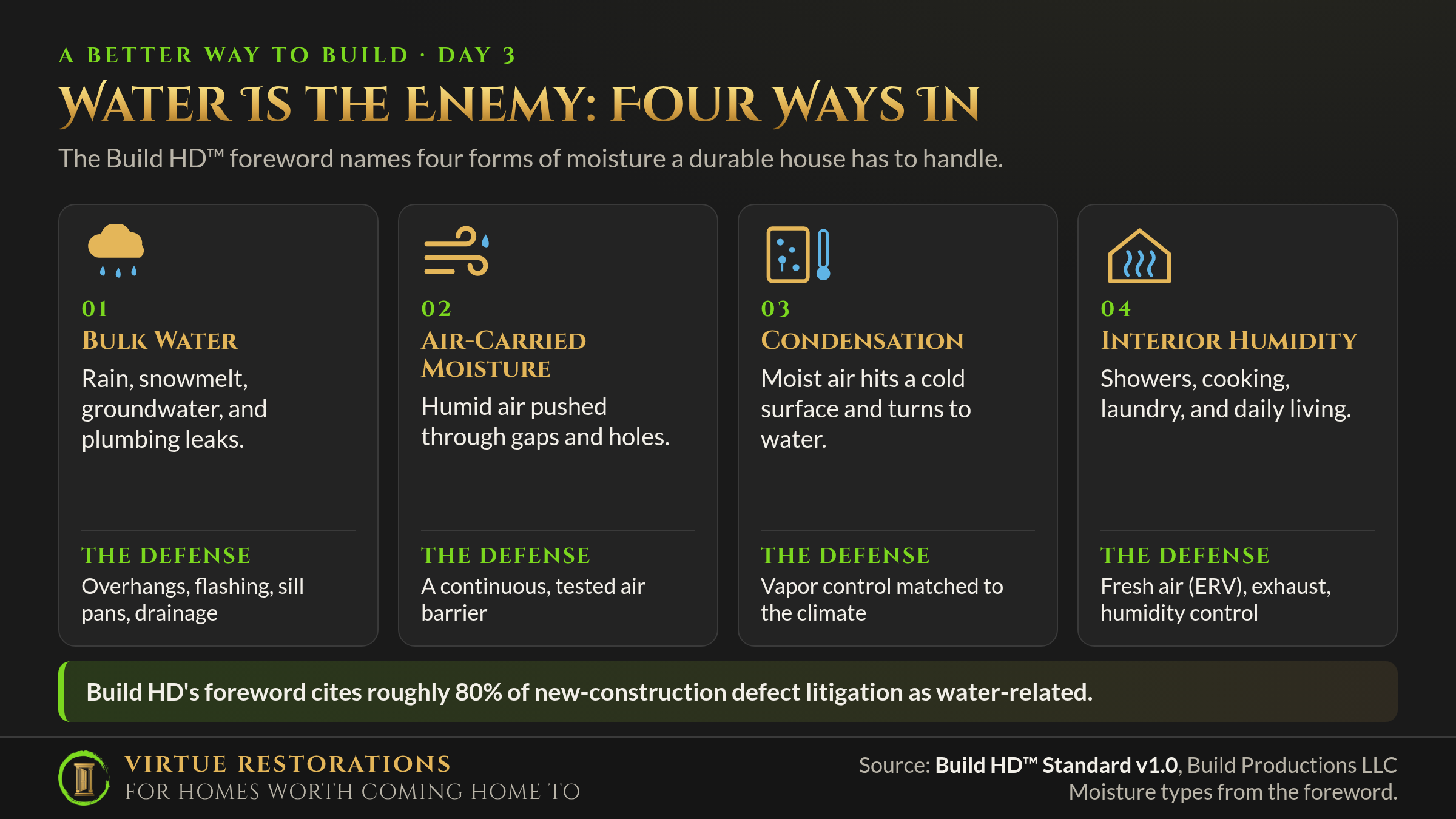
- Bulk water. Liquid water: rain, snowmelt, groundwater, and plumbing leaks. It moves by gravity and wind, and it will find any path you leave open.
- Air-carried moisture. Air holds water vapor. When humid air is pushed through gaps (outlet boxes, top plates, plumbing holes), it carries that moisture into walls and attics.
- Condensation. When moist air touches a surface colder than its dew point, the vapor turns back into liquid water. Think of a cold glass of iced tea on a July afternoon, except it's happening inside a wall.
- Interior humidity. Showers, cooking, laundry, houseplants, and simply breathing add moisture to the air inside. In a tighter, more efficient house, that moisture has nowhere to go unless you give it somewhere.
What the code requires
The code does address water in places. It requires flashing at roof-to-wall intersections and valleys, flashing at window and door openings, a water-resistive barrier behind siding, and mechanical ventilation in tighter new homes.
But according to Build HD, code doesn't require sill pans under windows, head flashings over doors, or robust continuous air barriers. And while the code requires fresh air, Build HD's foreword points out that fresh air has to be paired with thoughtful humidity control. Code mostly leaves that pairing to chance.
What Build HD calls for
Build HD answers each of the four forms on purpose:
- Against bulk water: two-foot overhangs where rainfall exceeds 20 inches a year, gutters and kickout flashings, sloped sill pans, a taller foundation reveal, real waterproofing below grade, and leak detection at fixtures.
- Against air-carried moisture: a continuous air barrier with every penetration sealed, verified with a blower-door test.
- Against condensation: vapor control designed for the climate zone and checked by analysis, plus sealed, insulated ducts.
- Against interior humidity: planned fresh air through an energy-recovery ventilator (ERV), bath and kitchen exhaust, and dedicated humidity control tied into the HVAC system.
We'll cover each of these in detail over the coming weeks.
Why it works
Each form of moisture moves differently, so each needs its own defense:
- Bulk water follows gravity and pressure. You stop it with overlapping layers that shed water downward and outward, like shingles.
- Air leaks can carry far more moisture into a wall than vapor slowly soaking through solid materials. Sealing the holes matters more than most people expect.
- Condensation is about temperature. Put the vapor control on the right side of the wall for your climate, keep cold surfaces away from humid air, and condensation has nowhere to form.
- Humidity is about balance. A house that's tight enough to be efficient needs a planned way to bring in fresh air and remove moisture.
Miss any one of the four and the other three can't make up for it.
What it means when Virtue remodels your existing home
Before we talk about tile, cabinets, or paint, we ask where the water comes from and where it goes:
- Finishing a basement? First we look at grading, gutters, downspouts, and signs of past seepage. Finishes on a damp foundation don't last.
- Remodeling a bathroom? The exhaust fan should vent outdoors, not into the attic, and the shower should be built and flood-tested to hold water.
- Opening a wall? We seal the penetrations we can reach before the wall closes back up.
- Replacing windows or doors? They get sloped pans and proper flashing.
Health comes before beauty. If the water isn't handled, the money spent on finishes is at risk.
The virtue behind it
This post reflects Compassion: love for the neighbor whose home is disrupted. A water problem isn't just a building problem. It's a family dealing with musty air, damaged belongings, and repair bills they didn't plan for. Getting water right is how we care for the people who live in the house long after we've packed up.
Water management sits on the integrity floor of all three of our project paths: Rebuild, Reform, and Reimagine. It's never an upgrade.
Seeing signs of water and not sure where it's coming from? Reach Jacob at Jacob@virtuerestorations.com or (513) 568-5819. We'll start by finding the source.
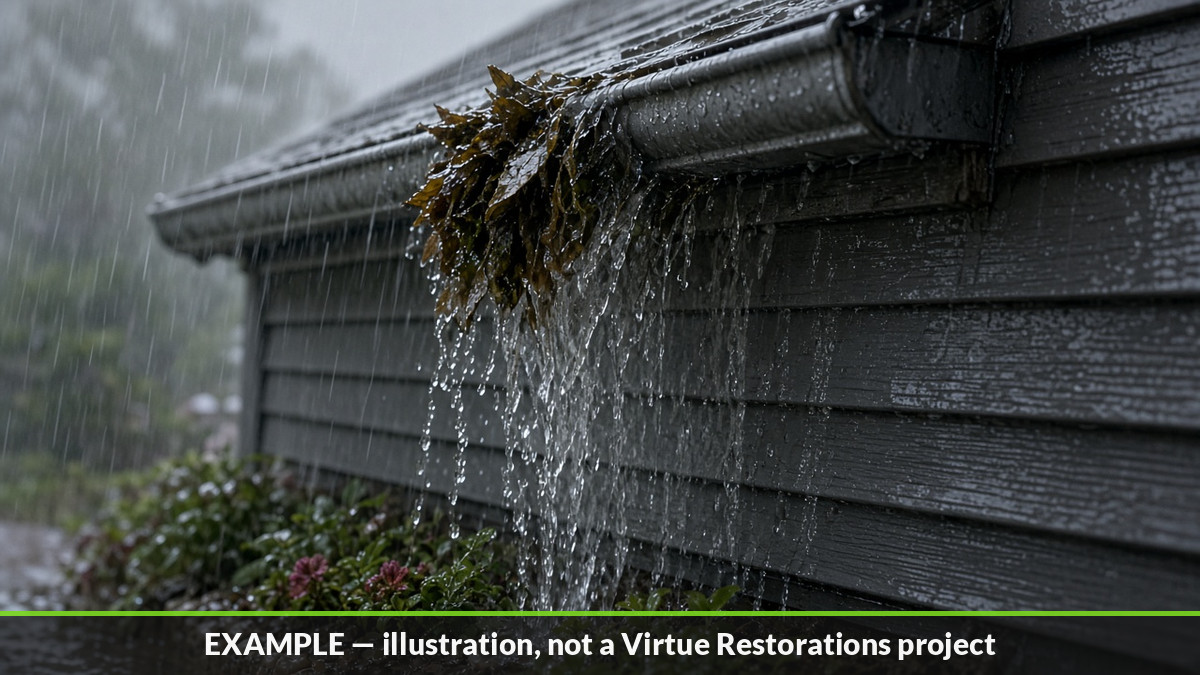
Example illustration, not a Virtue Restorations project