
A Better Way to Build · Day 2 of 30
Code Minimum vs. a Better Standard
"Built to code" means the legal minimum. Here's what the code leaves out, and what an above-code standard like Build HD asks for instead.
- VALOR
- BUILD HD™: Foreword · Standard overview · R609 · R802 · R903.2 · R403.1 · R702 / P2709
"Don't worry, it's all built to code."
Most homeowners hear that sentence at some point, and it sounds reassuring. It should mean something, too. Code matters, and every project we do has to satisfy it.
But "built to code" doesn't mean "built well." It means "built to the legal minimum." Those are different promises, and the gap between them is where many houses get into trouble.
The problem
A building code is a floor, the lowest a house can go and still be legal. Nobody would call the minimum passing grade on a test the goal, yet in home building "up to code" often gets treated as the finish line.
The Build HD™ Standard, published by Build Productions LLC (the team behind Matt Risinger's The Build Show), is honest about this in its foreword. Code, it says, "doesn't address some of the most significant long-term failure points." It names some of them: sill pans under windows, head flashings over doors, and robust continuous air barriers. Inspectors rarely flag those details, but leaving them out can shorten a home's life dramatically.
What the code requires
Most homes in the U.S. are built under some version of the International Residential Code (IRC). The code sets minimums for structure, fire safety, energy, plumbing, mechanical, and electrical work. A permit and inspections confirm those minimums were met.
That's real protection, and it matters. But the code is written to be the least that's acceptable across a huge range of houses, budgets, and climates. On many of the details that decide whether a house stays dry for decades, it's silent or vague.
What Build HD calls for
Build HD walks through 89 requirements across 20 chapters of the IRC. What makes it useful is how it's laid out: every entry shows what Build HD requires, what the code requires, and what documentation proves the work was done. You can see the gap side by side.
Here are five examples where the difference is easy to picture:
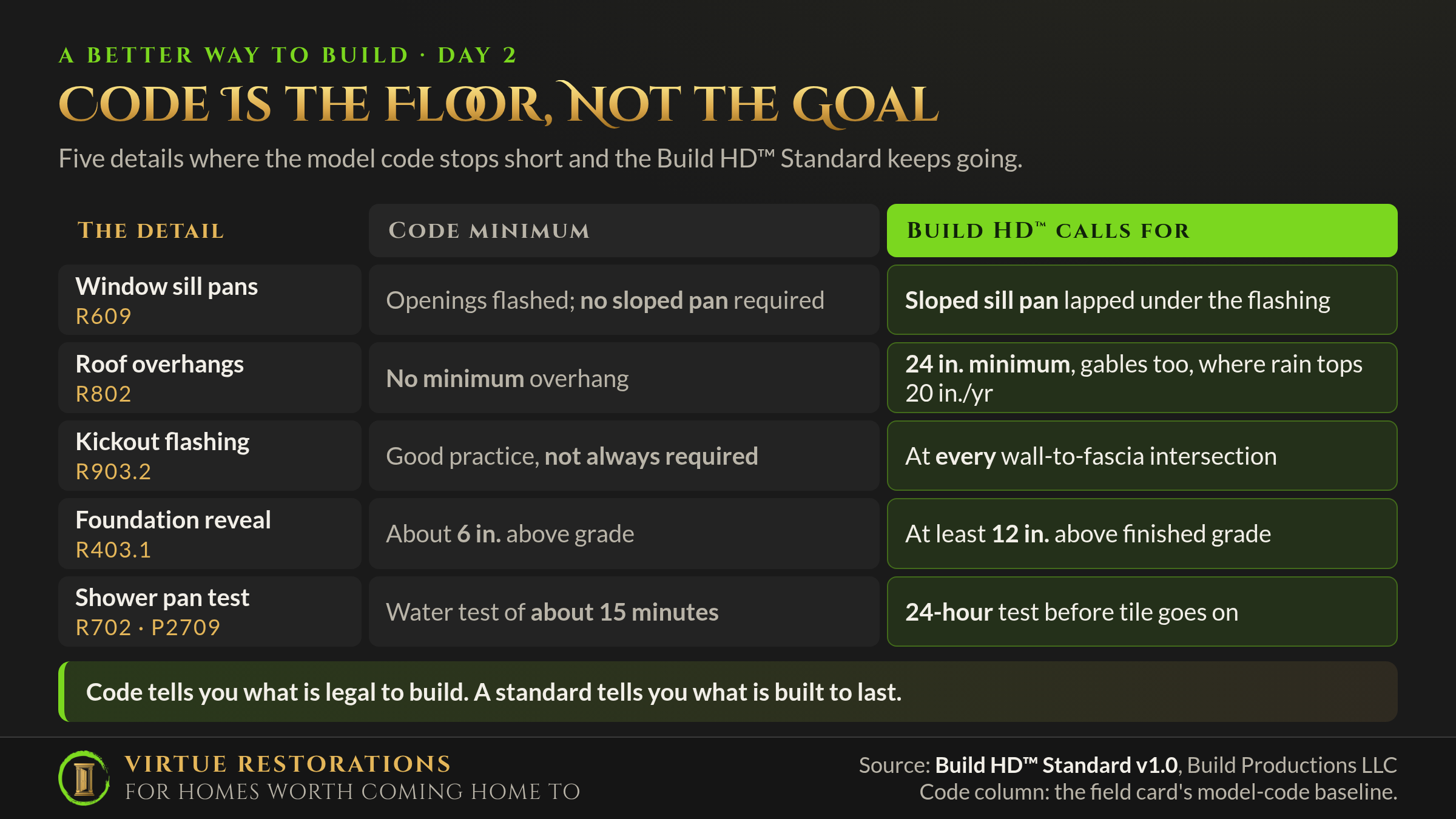
- Window sill pans. Code requires window openings to be flashed. Build HD calls for a sloped pan under every window and door, lapped so water drains out, not in.
- Roof overhangs. Code sets no minimum. Where rainfall tops 20 inches a year, Build HD calls for overhangs of at least two feet, gable ends included.
- Kickout flashing. Where a roof edge runs into a wall, a small kickout flashing steers water away from the siding. The code treats kickouts as good practice. Build HD requires one at every such spot.
- Foundation reveal. Code asks for roughly 6 inches of foundation above grade. Build HD calls for at least 12, keeping wood framing and siding farther from wet soil and splashback.
- Shower pan testing. A typical code water test runs about 15 minutes. Build HD calls for a 24-hour test before any tile goes on.
None of these is exotic. They're ordinary details done carefully, at the moment when doing them right is cheap.
Why it works
Build HD's foreword cites a striking figure: roughly 80% of new-construction defect litigation is related to water, whether from rain, groundwater, or moisture inside the home. That's Build Productions' figure, not ours, but it lines up with what remodelers see when they open walls.
Most of those water problems trace back to small, hidden details: a window without a pan, a roof edge without a kickout, a shower pan that was never really tested. Once siding and tile go on, those details disappear. Fixing them later means tearing out finished work.
There's a second reason it works: documentation. Build HD expects proof, such as photos before walls close, water-test records, and test results. A promise you can check is worth more than a promise you can't.
What it means when Virtue remodels your existing home
When we remodel, the work we do must satisfy code, and we pull the permits it requires. That's the starting line, not the finish.
Where we're doing the work, we build toward the Build HD details that apply to an existing home:
- When we replace a window or exterior door, it gets a sloped sill pan and proper flashing.
- When we touch a roof-to-wall intersection, it gets a kickout.
- When we build a shower, we flood-test the pan for 24 hours before tile.
- When we close up a wall, we photograph what's inside it first, so you have a record.
To be clear about what we claim: Build HD has no certification program, and we won't pretend otherwise. What we can say truthfully is that we're guided by the standard, and we build toward it.
The virtue behind it
This post reflects Valor, the courage to tell the truth and do the hard right work. It would be easier to say "it's up to code" and move on. It takes more nerve to explain that code is the floor and that we intend to build above it.
These details sit on our integrity floor, so they come standard in all three of our project paths: Rebuild, Reform, and Reimagine. The paths change your materials and finishes. They don't change whether the water is managed.
If you'd like a contractor who explains the "why" behind the work, we'd be glad to hear about your project. Reach Jacob at Jacob@virtuerestorations.com or (513) 568-5819.
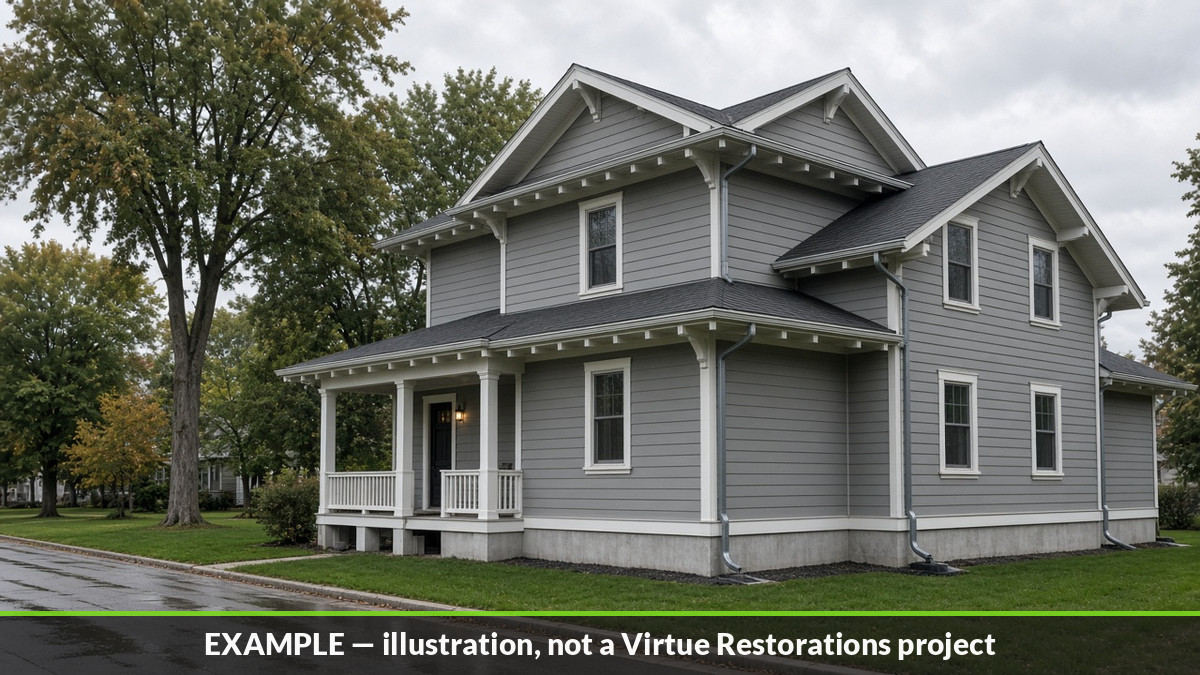
Example illustration, not a Virtue Restorations project