
A Better Way to Build · Day 15 of 30
Vapor and Dew Point: Why Walls Rot From the Inside
Moisture inside a house can turn to water inside a wall. How dew point works, why air leaks matter most, and how Build HD designs walls to stay dry.
- VALOR
- BUILD HD™: R702 Vapor Barrier (hygrothermal analysis)
When people picture a wall rotting, they usually imagine rain getting in from outside. But some of the worst wall damage we see starts on the inside of the house, from water that was never liquid until it reached the wall.
That sounds strange until you understand one idea: dew point.
The problem
Indoor air always holds some water vapor from cooking, showers, laundry, plants, and breathing. You can't see it, but it's there. When that vapor touches a surface that's cold enough, it turns back into liquid water.
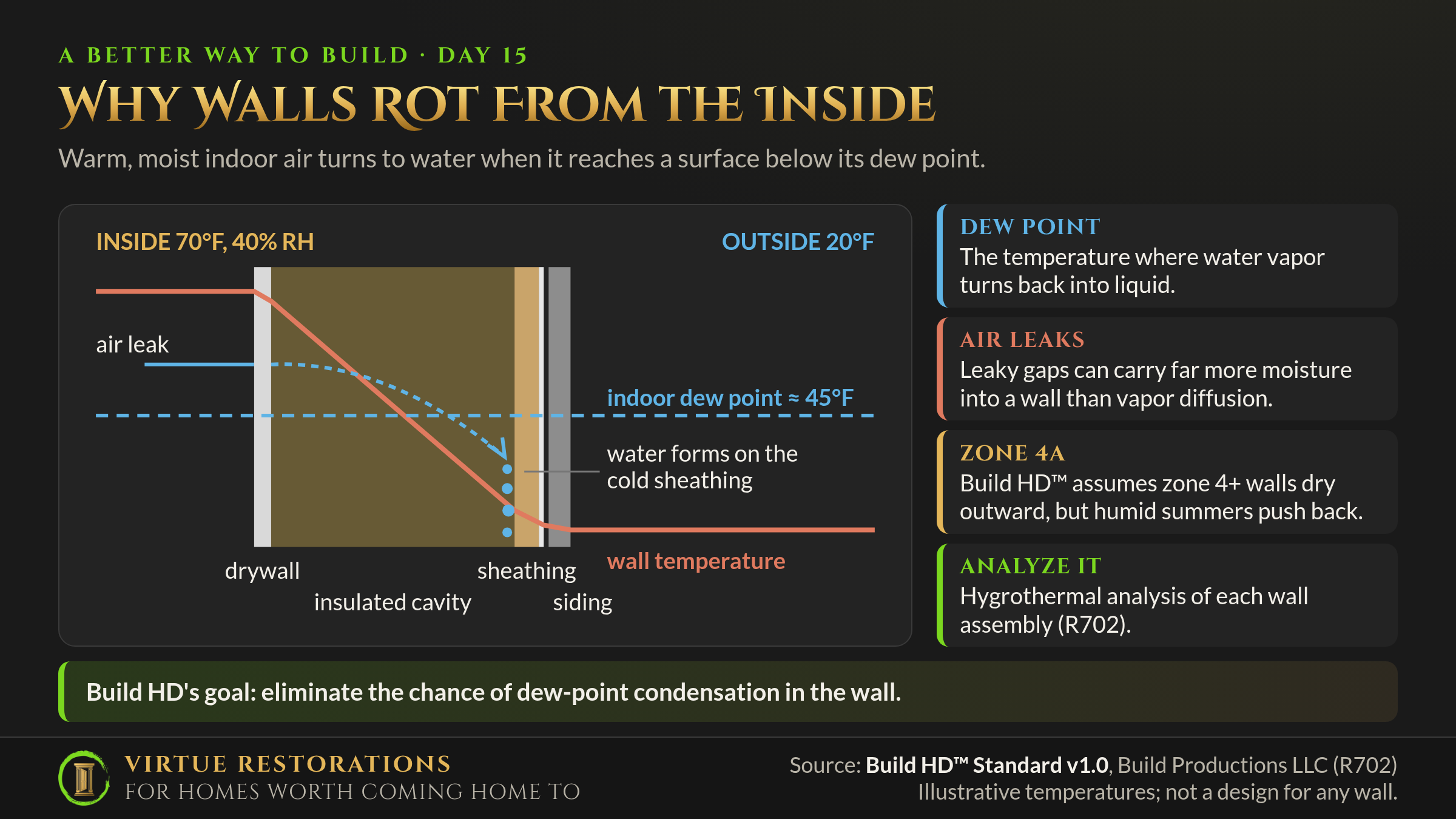
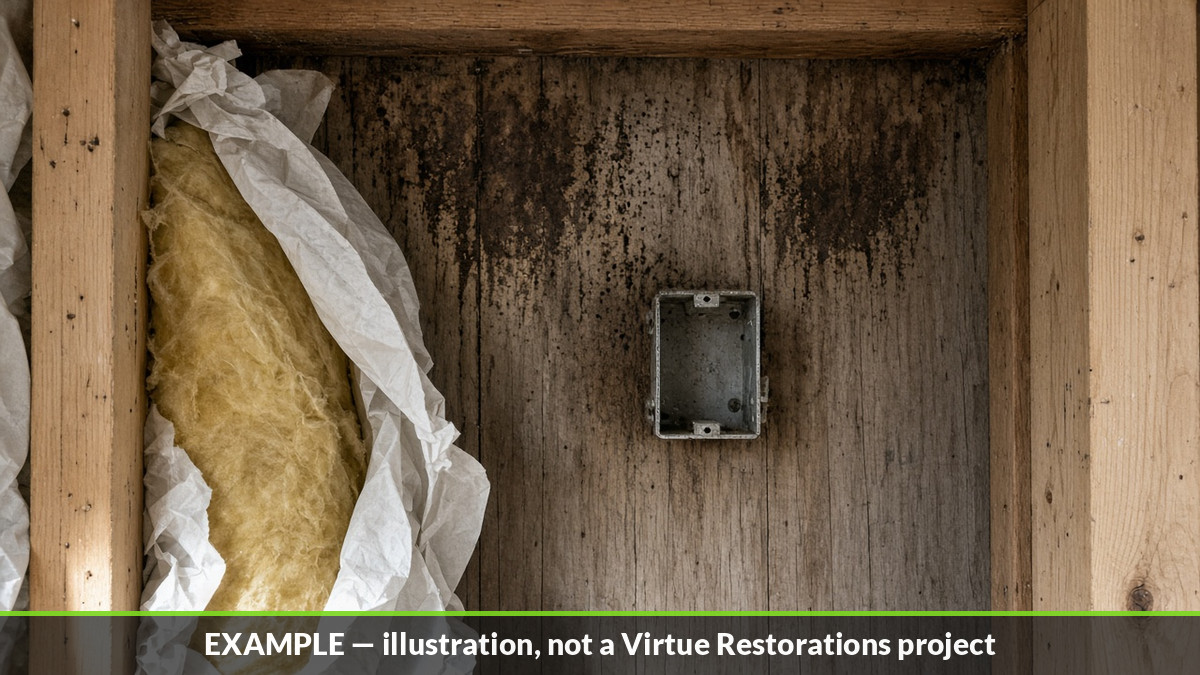
You see this every summer on a glass of iced tea. In winter, the same thing can happen inside a wall. Warm, moist indoor air finds its way into the wall cavity, reaches the cold back side of the exterior sheathing, and condenses. Night after night, that water soaks into the wood. Months later it shows up as mold, rusted nails, or soft sheathing, often with no stain on the inside wall at all.
What the code requires
The model code addresses vapor retarders by climate zone, and under slabs it calls for a 6-mil vapor retarder. According to the Build HD™ Standard, the code does not call for an analysis of how a particular wall assembly will handle moisture in its climate.
What Build HD calls for
Build HD, published by Build Productions LLC (the team behind Matt Risinger's The Build Show), makes moisture control part of the design. Its R702 vapor requirement calls for:
- A hygrothermal analysis of each wall assembly for its climate zone. Hygrothermal simply means "heat and moisture." The analysis models how temperature and moisture move through the wall over the seasons.
- The stated goal: eliminate the chance of dew-point condensation in the assembly.
- Vapor control designed into the wall in the right place, instead of added by habit.
Build HD also gives a general rule of thumb: climate zones 3 and below are generally assumed to dry to the inside, and zones 4 and above are generally assumed to dry to the outside. According to the U.S. Department of Energy's climate zone map, Boone, Kenton, Campbell, and Grant counties sit in climate zone 4A, a mixed-humid climate. So the rule of thumb points us toward walls that can dry outward. But it's only a starting point, which is exactly why Build HD asks for analysis.
Code minimum
Build HD™ calls for
Why it works
Dew point is just a temperature. Air at 70°F and 40% relative humidity has a dew point of about 45°F. Any surface colder than that will collect water from that air. On a 20°F winter day, the sheathing in a typical insulated wall can easily be colder than 45°F.
Air leaks carry far more moisture than diffusion. Water vapor also moves slowly through solid materials, which is called diffusion. But building scientists have long found that air leaking through a gap can carry far more moisture into a wall than diffusion through the drywall does. That's why air sealing (Day 14) is the first line of defense against condensation.
Vapor control has to fit the climate. In a cold climate, the main risk is winter moisture moving outward, so walls are built to slow vapor from the inside. In a hot, humid climate, the risk runs the other way. Zone 4A gets both: cold winters and humid summers. A wall here needs to slow winter moisture without trapping summer moisture that's being driven inward, for example by sun on wet siding. Plastic sheeting on the inside of the wall can work against you in summer, which is why the right answer depends on the whole assembly.
Analysis replaces habit. A hygrothermal model lets a designer test a wall on paper, season by season, before building it.
What it means when Virtue remodels your existing home
We won't run a computer model for a bathroom remodel. We will apply the same principles every time we open a wall:
- Air seal first. When walls or ceilings are open, we seal penetrations, top plates, and gaps before insulating. That's the biggest condensation defense we have.
- No plastic by habit. We don't add interior polyethylene sheeting to walls out of habit. We choose vapor control for the assembly and our climate, often with materials that slow vapor without trapping it.
- Let walls dry. When we re-side or add exterior insulation, we pay attention to which direction the wall can dry and avoid sandwiching it between two vapor-tight layers.
- Control the source. Bath and kitchen fans vented outdoors, and attention to indoor humidity, keep less moisture in the air to begin with.
- Get analysis when it's warranted. For unusual wall assemblies, a major envelope retrofit, or interior insulation of old masonry, we'll recommend analysis by a qualified professional before we build.
The virtue behind it
This post reflects Valor, the courage to tell the truth and do the hard right work. "That's how we've always built it" is one of the most expensive sentences in construction. It takes courage to question a habit, like plastic on every wall, and to explain why the right answer depends on the wall.
Air sealing and vapor control chosen for the assembly sit on our integrity floor, in every path: Rebuild, Reform, and Reimagine. (Path mapping is provisional while we finalize it.)
Seeing mold or moisture inside walls and not sure where it's coming from? Reach Jacob at Jacob@virtuerestorations.com or (513) 568-5819. We serve Boone, Kenton, Campbell, and Grant counties.
Example illustration, not a Virtue Restorations project