
A Better Way to Build · Day 14 of 30
Airtightness: What a Blower Door Test Tells You
A blower door test measures how leaky a house really is. Why Build HD targets 2.0 ACH50 for new homes, and how we test, improve, and measure existing ones.
- HUMILITY
- BUILD HD™: N1102.4 Air Sealing
Every house has a list of complaints that sound like opinions. The upstairs bedroom is always hot. The family room is drafty. There's dust on everything a day after cleaning. The furnace never seems to stop running.
Many of those complaints have the same root cause: air leaking in and out of the house in places nobody planned. And unlike most building problems, this one can be measured in an afternoon.
This week of the series is about air and vapor, the second and third forms of moisture we met in Week 1. We start with the tool that makes air leaks visible: the blower door.
The problem
Air leaks hide in plain sight: gaps around attic hatches and recessed lights, holes where pipes and wires pass through top plates, unsealed rim joists in the basement, and cracks around windows, doors, and chimneys. Individually, they're small. Together, they can add up to the equivalent of leaving a window open all year.
Leaky air costs more than comfort. In winter, warm indoor air escaping through the ceiling carries moisture into the attic. In summer, humid outdoor air pulled in through walls and floors carries moisture into the house. As we'll see tomorrow, air leaks are one of the main ways water gets inside walls.
What the code requires
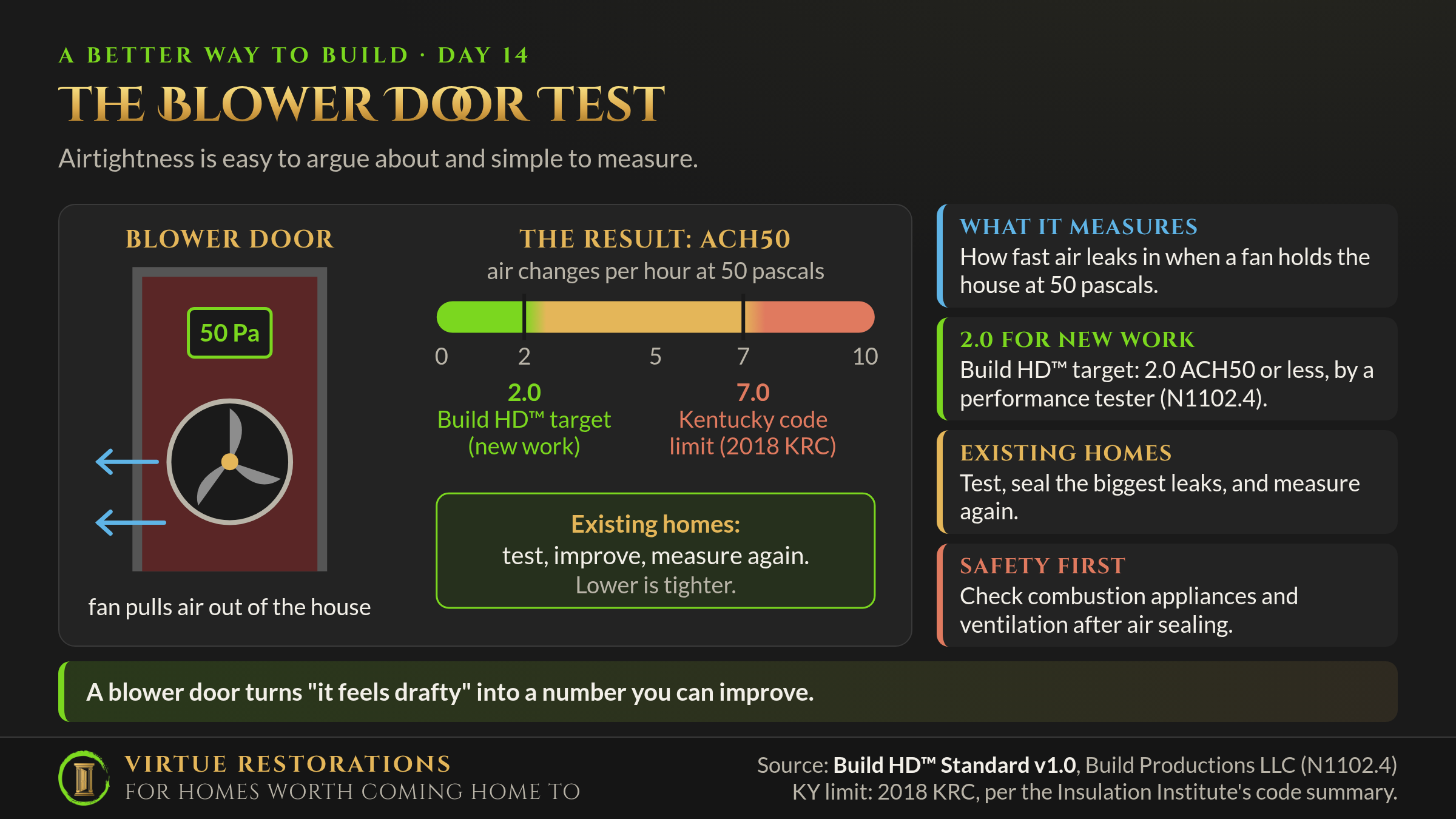
Model codes have tightened air-leakage limits for new homes over the years. Here in Kentucky, the residential code currently in force (the 2018 Kentucky Residential Code, which uses older energy provisions) allows a tested result of up to 7 air changes per hour at 50 pascals (7.0 ACH50), or a visual checklist in place of a test, according to the Insulation Institute's summary of the Kentucky code. Existing homes being remodeled generally have no airtightness test requirement at all.
What Build HD calls for
The Build HD™ Standard, published by Build Productions LLC (the team behind Matt Risinger's The Build Show), sets a much tighter bar in its N1102.4 air-sealing requirement:
- A continuous perimeter air barrier at the exterior walls and roof.
- Every penetration sealed with tapes, sealants, or gaskets before the siding goes on.
- A whole-home blower door test before completion, with a maximum of 2.0 ACH50, with results published by a qualified performance-testing professional.
- Attached garages insulated and isolated from the living space (more on that on Day 19).
Code minimum
Build HD™ calls for
Why it works
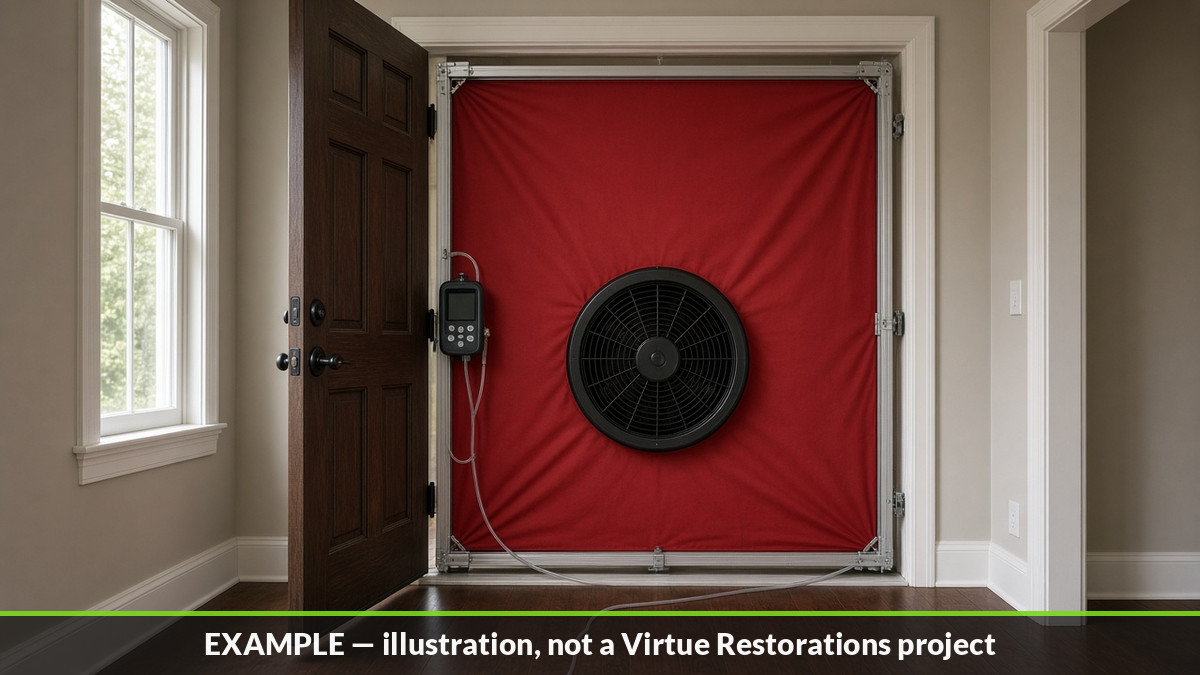
A blower door is a calibrated fan mounted in an exterior doorway. It pulls air out of the house until the inside is at 50 pascals of pressure below the outside, roughly the pressure of a stiff breeze on every surface at once. A gauge measures how much air the fan must move to hold that pressure. That flow, divided by the house's volume, gives air changes per hour at 50 pascals (ACH50). Lower is tighter.
The test does two jobs. It gives you a number, so you can compare before and after. And while the house is under pressure, a tester can walk around with a smoke pencil or an infrared camera and find the leaks that matter most.
Build HD's 2.0 ACH50 is a target for new construction, where the air barrier can be designed and sealed before anything is covered up. Existing homes are a different story, and we're honest about that below.
One important safety point: making a house tighter changes how it breathes. Fuel-burning appliances like older furnaces, water heaters, and fireplaces need air to burn and a clear path to vent. In a tighter house, exhaust fans and dryers can pull exhaust gases back into the home instead of letting them go up the flue. That's why combustion safety testing after air sealing is not optional.
What it means when Virtue remodels your existing home
We won't promise your 1950s home will test at 2.0 ACH50. Some existing homes can get close with major work; many can't without a full envelope rebuild. What we can promise is a process: test, improve, and measure.
- Test first on whole-house projects. When a project includes significant air sealing or insulation work, we'll recommend a blower door test before we start so we know where the house stands and where it leaks.
- Seal the biggest leaks first. Attic bypasses, top plates, rim joists, and penetrations usually give the most improvement for the effort.
- Seal what we open. On any project, when a wall, ceiling, or floor is open, we seal the penetrations we can reach before it closes.
- Measure again. A test-out shows what changed, so you're not taking our word for it.
- Check combustion safety every time. After significant air sealing, we have combustion appliances and venting tested for safe drafting and carbon monoxide, and we look at whether the house needs planned fresh air. If something isn't safe, we'll tell you and fix it before we call the job done.
- Aim for 2.0 on new work. On additions or a full envelope rebuild, we design toward Build HD's 2.0 ACH50 target and test to see how close we got.
The virtue behind it
This post reflects Humility: be willing to learn, and claim only what we can deliver. It's easy to say a house is "much tighter now." A blower door doesn't let us guess. It tells us, and you, what really changed. We'd rather show you a number than make a claim we can't back up.
Sealing what we open and checking combustion safety sit on our integrity floor, in every path. A whole-house test-and-seal project typically fits Reform, and an envelope rebuild toward 2.0 ACH50 fits Reimagine. This mapping is provisional while we finalize how Build HD items sit across Rebuild, Reform, and Reimagine.
Curious how leaky your house really is? Reach Jacob at Jacob@virtuerestorations.com or (513) 568-5819. We serve Boone, Kenton, Campbell, and Grant counties.
Example illustration, not a Virtue Restorations project