
A Better Way to Build · Day 16 of 30
Insulation That Works With the Wall
More insulation isn't the whole answer. Why Build HD asks for 25% above code plus continuous insulation, and how we insulate existing homes.
- EXCELLENCE
- BUILD HD™: N1102 Thermal Insulation
Ask most people how to make a house more comfortable and efficient, and they'll say "add insulation." It's a good instinct. But two houses with the same insulation on paper can perform very differently, and the difference comes down to how the insulation works with the rest of the wall.
The problem
Insulation has three common weak spots:
- Gaps and compression. Batts that are cut short, stuffed around wires, or squashed behind pipes leave voids. Heat flows right around them.
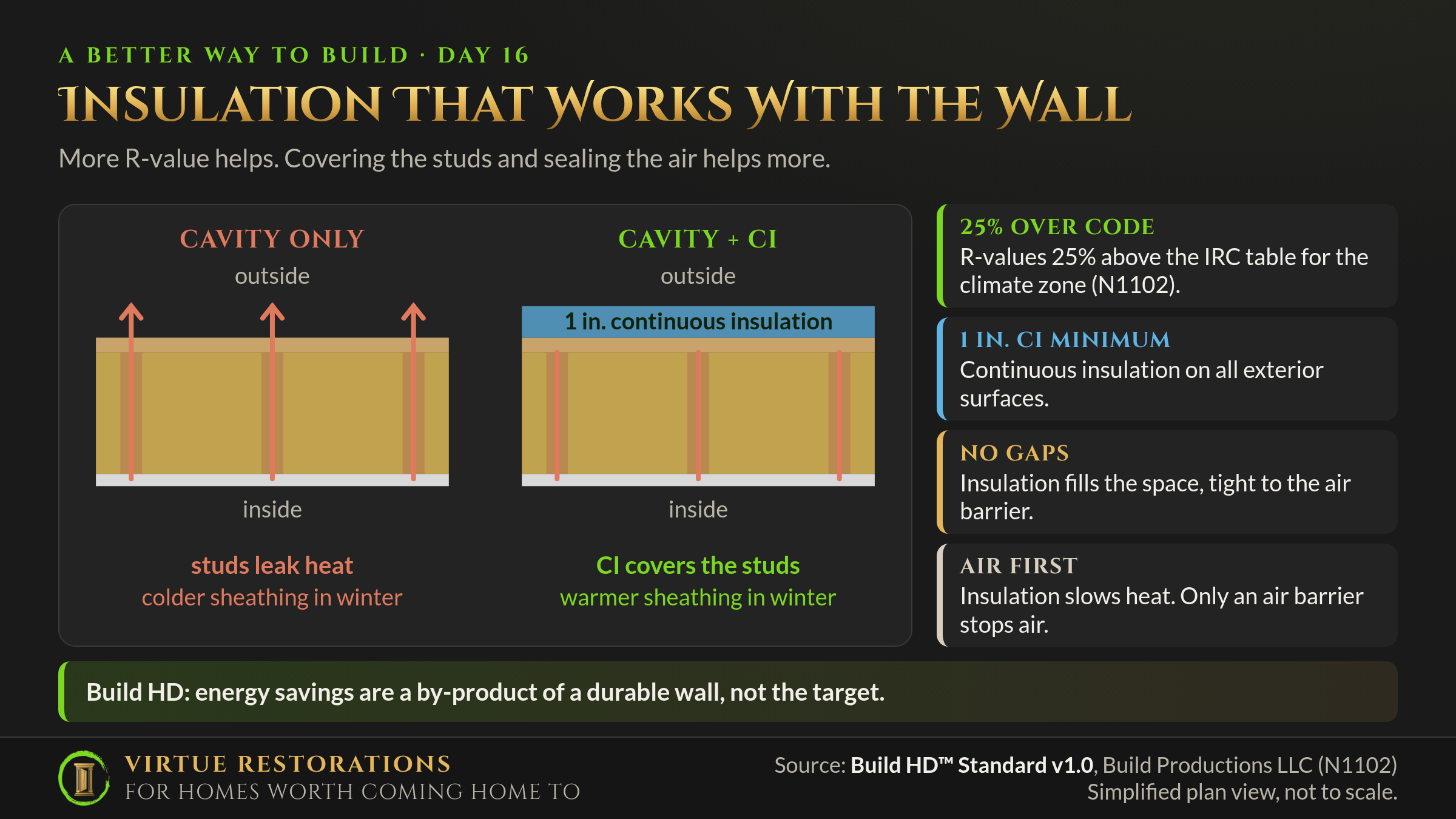
- Thermal bridges. In a typical wood-framed wall, the studs, plates, and headers can make up a sizable share of the wall area. Wood insulates far less than the insulation between it, so every stud acts as a small bridge for heat.
- Air moving through it. Fiberglass and other fibrous insulation slow heat, but they don't stop air. Air blowing through insulation carries heat, and moisture, right past it.
What the code requires
The model code sets minimum insulation R-values for each climate zone in its insulation table (IRC Table N1102.1.3). According to the Build HD™ Standard, continuous exterior insulation is required only for certain assemblies.
What Build HD calls for
Build HD, published by Build Productions LLC (the team behind Matt Risinger's The Build Show), opens its energy chapter with a telling line: energy performance is "a by-product of a durable enclosure, not the target." Its N1102 insulation requirement calls for:
- R-values 25% above the IRC minimums in the code's insulation table for the climate zone.
- At least 1 inch of continuous insulation (CI) on all exterior surfaces.
Build HD pairs this with the air-sealing requirement from Day 14, noting that continuous insulation and air sealing are also the two things that decide whether a wall assembly stays dry.
Code minimum
Build HD™ calls for
Why it works
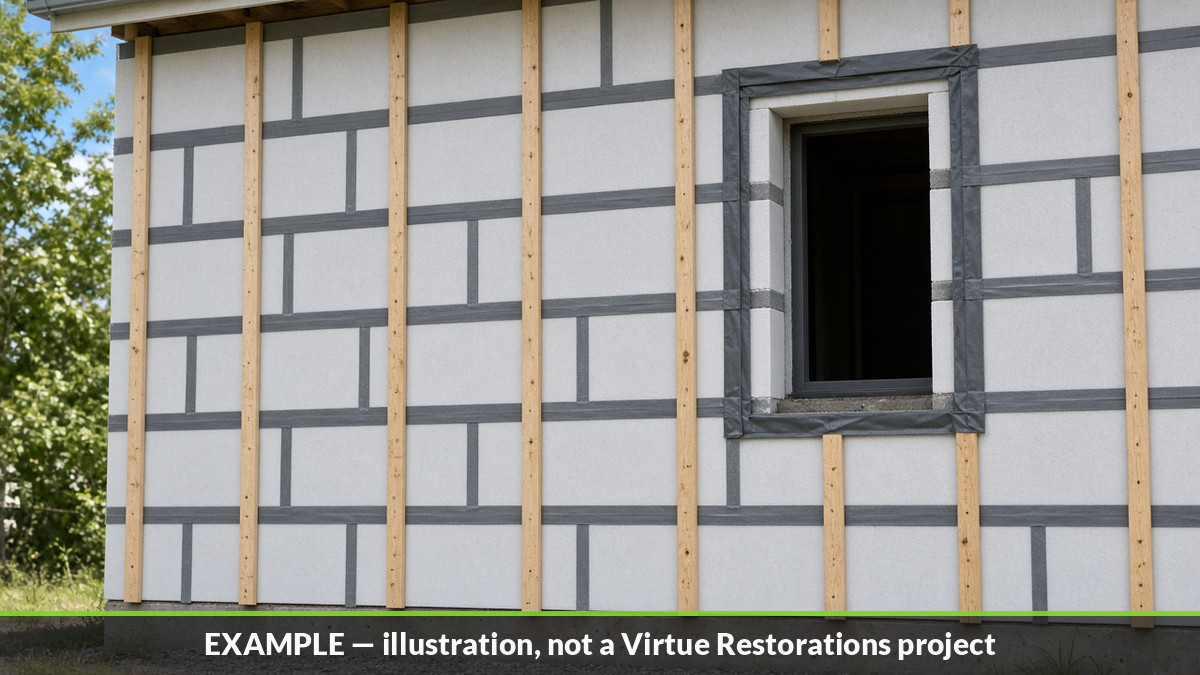
Continuous insulation covers the bridges. A layer of rigid or semi-rigid insulation outside the sheathing runs unbroken across studs, plates, and headers. Heat that used to slip through the framing now has to pass through the insulation too.
It also keeps the sheathing warmer. This is the durability payoff. On a cold day, sheathing outside a cavity-insulated wall gets cold, and as we saw in Day 15, cold sheathing is where condensation forms. Exterior insulation keeps the sheathing warmer for more of the winter, which lowers the risk. It needs to be designed with the wall's drying in mind, which is why Build HD pairs insulation with analysis.
Installation matters as much as R-value. Insulation that fills the cavity completely, sits in contact with the air barrier, and isn't compressed performs much closer to its label than insulation installed carelessly.
Air sealing comes first. Insulation slows heat; only an air barrier stops air. That's why Build HD treats insulation and air sealing as a pair.
What it means when Virtue remodels your existing home
We usually insulate an existing home in pieces, as each part of it opens up:
- Air seal before we insulate. In attics, walls, and rim joists, we seal the gaps first, then insulate.
- No gaps, no compression. We fit insulation around wires, pipes, and boxes instead of stuffing it, and we fill cavities completely.
- Aim above code where we insulate. Guided by Build HD's 25% target, we'll show you the code minimum for your area and what it takes to go beyond it.
- Offer continuous insulation when re-siding. When the siding is coming off anyway, adding exterior insulation is far easier than at any other time. We'll include it as an option and plan the window, door, and trim details around the thicker wall.
- Respect old walls. Insulating old solid masonry or balloon-framed walls from the inside can change how they dry. On those houses we'll go slowly and recommend analysis where it's warranted.
The virtue behind it
This post reflects Excellence, our love of good work. Nobody sees insulation once the drywall is up. Excellence means caring whether every cavity is full, every gap is sealed, and every batt is fitted, because the people living there will feel the difference in every season.
Air sealing first and careful installation sit on our integrity floor, in every path. Continuous exterior insulation during re-siding typically fits Reform or Reimagine. This mapping is provisional while we finalize how Build HD items sit across Rebuild, Reform, and Reimagine.
Thinking about insulation upgrades? Reach Jacob at Jacob@virtuerestorations.com or (513) 568-5819. We serve Boone, Kenton, Campbell, and Grant counties.
Example illustration, not a Virtue Restorations project