
A Better Way to Build · Day 17 of 30
Crawlspaces and Basements: Sealed and Conditioned
Vented crawlspaces can pull humid air under your floors. Why Build HD calls for sealed, insulated, conditioned crawlspaces and basements.
- COMPASSION
- BUILD HD™: R408 Crawl Spaces / Basements
If your house sits over a crawlspace, there's a good chance you've never been down there, and there's a good chance it's not pleasant. Damp soil, sagging insulation, a musty smell, and the occasional critter are common in crawlspaces across Northern Kentucky.
For decades, the standard advice was to vent crawlspaces to the outdoors so they could "breathe." Building science has shown that in a humid climate like ours, that advice often backfires.
The problem
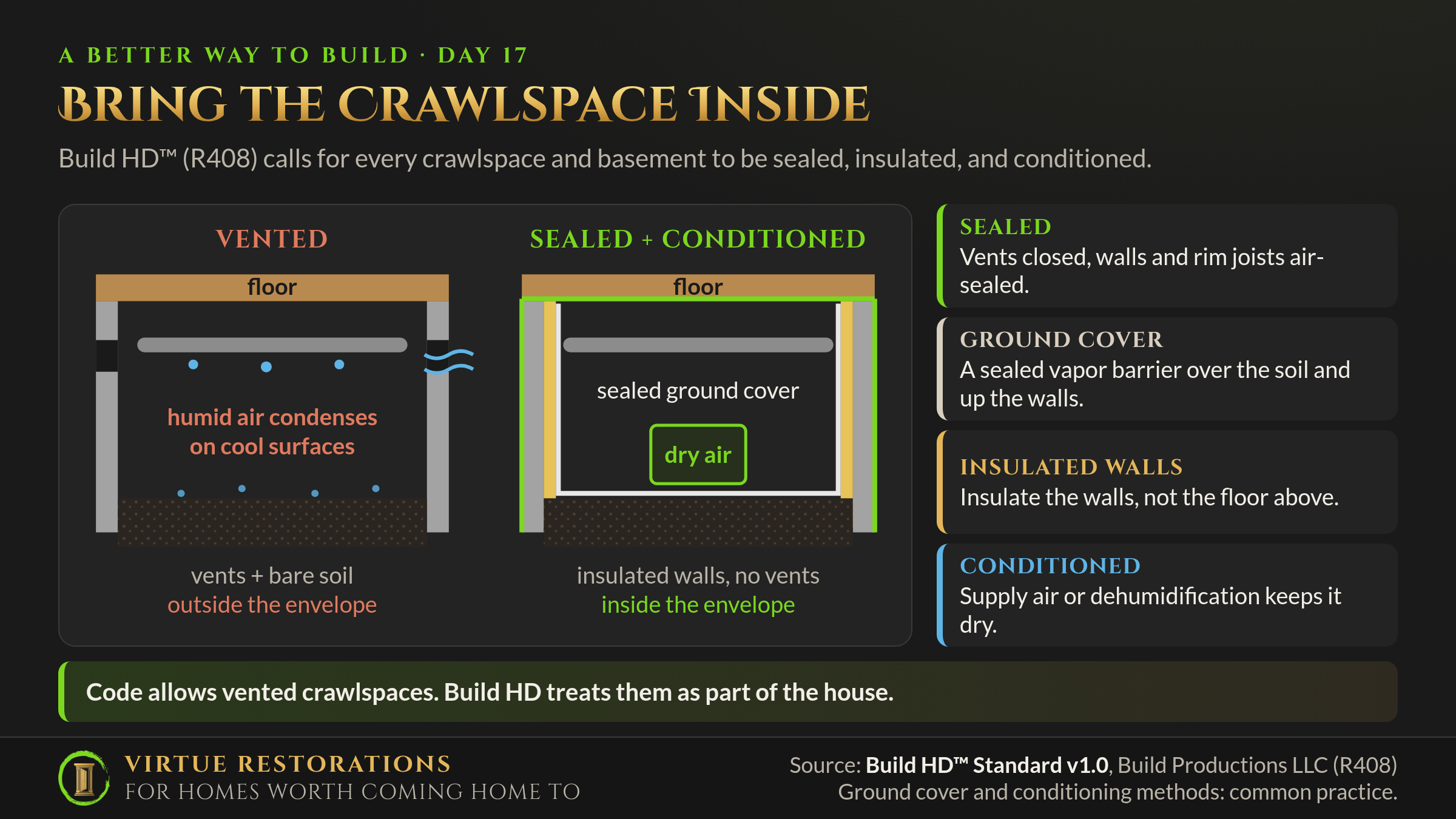
A vented crawlspace is, by design, outside. In summer, warm humid air flows in through the vents. The crawlspace is shaded and cooled by the ground, so ducts, pipes, and the underside of the floor are often cooler than the outdoor air's dew point. The result is condensation, the same physics we covered on Day 15. Wood framing absorbs moisture, fiberglass insulation sags and drops, and mold can grow.
The crawlspace is connected to the house above through gaps in the floor, plumbing holes, and duct leaks. Warm air rises and leaks out of the top of a house, which pulls replacement air in from below, so some of that damp, musty crawlspace air ends up in the living space.
What the code requires
The model code permits vented crawlspaces. Sealed, insulated, and conditioned crawlspaces are an allowed option, not a requirement.
What Build HD calls for
The Build HD™ Standard, published by Build Productions LLC (the team behind Matt Risinger's The Build Show), is simple and firm in its R408 requirement: all crawlspaces and basements must be sealed, insulated, and conditioned. It lists a conditioned-space design detail, an inspection record, and a blower door test as supporting documentation.
This ties back to the envelope idea from Day 5: the crawlspace becomes part of the inside of the house, inside one clearly defined and continuous boundary.
Code minimum
Build HD™ calls for
Why it works
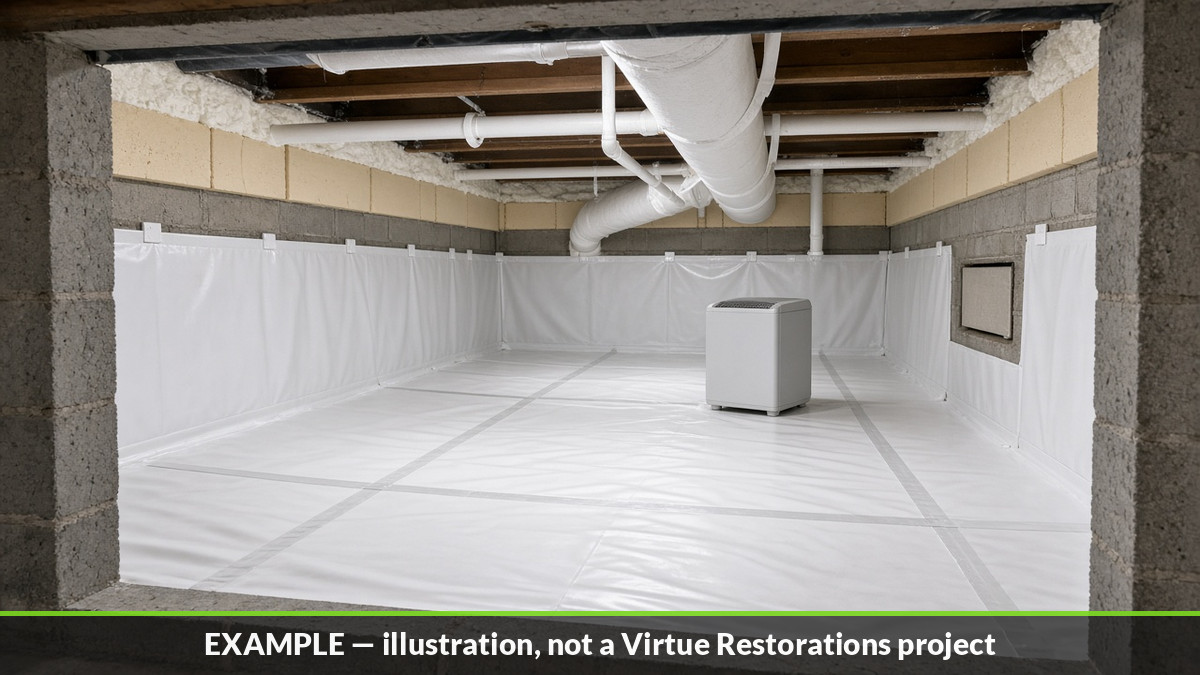
Sealing a crawlspace changes it from a damp, semi-outdoor space into a small, dry, semi-conditioned room. A typical approach includes:
- Closing and sealing the vents and air-sealing the walls and rim joists, so humid outdoor air stays out.
- A sealed ground cover: a durable vapor barrier laid over the soil, lapped and taped at the seams, and run up the walls, so moisture from the ground stays in the ground.
- Insulating the walls instead of the floor above, so the crawlspace sits inside the thermal envelope along with any ducts and pipes down there.
- Conditioning the space, typically with a small amount of supply air from the HVAC system or a dedicated dehumidifier, as the code allows, so humidity stays under control.
Basements follow the same logic. A basement is part of the house, and its walls and floor should be treated as part of the envelope: dry, air-sealed, and insulated.
What it means when Virtue remodels your existing home
Crawlspace and basement work is one of the most meaningful health upgrades in an older home, but it has to be done in the right order:
- Water first. Before we seal anything, we deal with bulk water: grading, gutters, downspouts, and any groundwater (Days 7, 8, and 13). Sealing a crawlspace that floods just traps the water.
- We don't add vents. We won't add new vents to a crawlspace, and when we encapsulate, we close the ones that exist.
- Seal, cover, insulate, condition. When we encapsulate, the plan includes all four steps, not just a sheet of plastic on the dirt.
- Mind the appliances. If there's a fuel-burning furnace or water heater in the crawlspace or basement, we check its combustion air and venting as part of the plan, because sealing the space changes its air supply.
- Look for pests and wood damage. We check for termite activity and soft framing before the space is closed up.
The virtue behind it
This post reflects Compassion: love for the neighbor whose home is disrupted. The air in a crawlspace doesn't stay in the crawlspace. Caring for a family means caring about the musty air they breathe every day, even though it comes from a place they never see.
Fixing water problems first sits on our integrity floor, in every path. A full crawlspace encapsulation typically fits our Reform path. This mapping is provisional while we finalize how Build HD items sit across Rebuild, Reform, and Reimagine.
Have a crawlspace you'd rather not think about? Reach Jacob at Jacob@virtuerestorations.com or (513) 568-5819. We serve Boone, Kenton, Campbell, and Grant counties.
Example illustration, not a Virtue Restorations project