
A Better Way to Build · Day 6 of 30
Two-Foot Overhangs: The Oldest Rain Gear a House Can Wear
Deep roof overhangs keep rain off your walls. Why Build HD calls for two feet in rainy climates, and what that means for an existing home.
- HUMILITY
- BUILD HD™: R802 Roof Shapes & Overhangs
Walk down almost any street of older homes in Northern Kentucky and look up. Many of those houses wear their roofs like a wide-brimmed hat, with eaves that reach well past the walls.
Now look at a lot of newer houses. The roof often stops just a few inches past the siding, and on the gable ends there may be no overhang at all. It's a cleaner look and it saves some lumber. It also leaves the walls standing out in the rain.
This week of the series is about shedding bulk water: liquid rain and runoff, the first of the four kinds of moisture we covered in Week 1. We start at the top of the house, because the best way to keep water out of a wall is to keep it off the wall in the first place.
The problem
Every gallon of rain that lands on a wall has to go somewhere. Most of it runs down the siding. Some of it finds its way behind trim, into window and door joints, and through tiny gaps in caulk that has aged in the sun.
A wall that rarely gets wet doesn't have to be perfect. A wall that gets soaked in every storm has to be perfect forever, and no wall stays perfect forever. Paint fails sooner, caulk fails sooner, and small flashing mistakes turn into rot.
What the code requires
Under the model code, there's no minimum roof overhang. A builder can stop the roof at the wall line and still pass inspection.
What Build HD calls for
The Build HD™ Standard, published by Build Productions LLC (the team behind Matt Risinger's The Build Show), treats overhangs as weather protection, not a style choice. Its R802 requirement says:
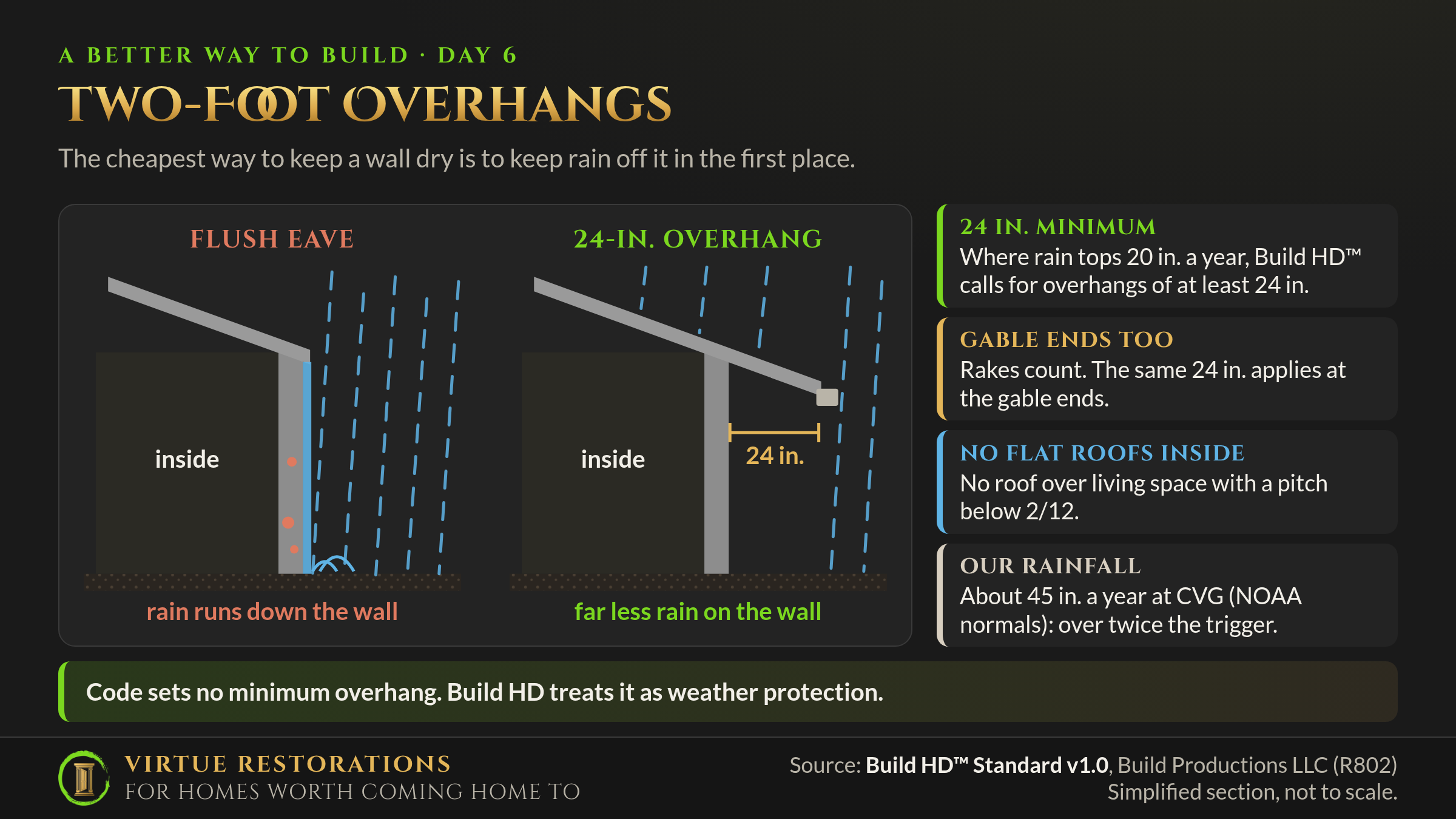
- Where annual rainfall is above 20 inches, overhangs should be at least 24 inches, and that includes the gable ends, not just the eaves.
- No roof over conditioned (living) space should have a pitch below 2/12. Very low slopes drain slowly and leave water sitting on the roof longer.
Code minimum
Build HD™ calls for
How does our area compare to that 20-inch trigger? NOAA's 1991–2020 climate normals put average yearly precipitation at the Cincinnati/Northern Kentucky airport at about 45 inches, more than twice the threshold. By Build HD's measure, deep overhangs belong on houses here.
Why it works
Rain rarely falls straight down. Wind drives it at an angle, so a short overhang shields only a sliver at the top of the wall. A two-foot overhang shelters much more of the wall, and especially the windows and doors near the top, where leaks often start.
An overhang also helps in ways that are easy to miss:
- Less wetting means more drying. Walls dry between storms. The less water they take on, the more easily they keep up.
- Finishes last longer. Paint, stain, and sealants break down faster when they're wet and sun-baked over and over.
- The gable ends matter too. Many houses with decent eaves have almost nothing at the rakes. That's why Build HD names gable ends specifically.
Overhangs aren't a new idea. As we noted in Day 1, most century-old houses had them. Builders who had no housewrap and no sealant tape learned that the roof was their first and best defense.
What it means when Virtue remodels your existing home
Most of the time we're not designing a roof from scratch, so here's how this principle shows up in our work:
- We don't shrink what you have. When we re-roof or replace fascia and soffits, we keep your existing overhangs and repair rotted rafter tails rather than cutting them back.
- We look at the walls under short eaves. Weathered paint, stained siding, and soft trim beneath a shallow overhang tell us where water is hitting hardest, and we look there first.
- We plan overhangs into additions and major exterior work. On a new addition, porch, or roof rebuild, we design toward Build HD's 24 inches, gables included, wherever the house and your neighborhood's character allow it.
- Where we can't add overhang, we lean harder on the other defenses. That means gutters, kickout flashings, careful window flashing, and drainage behind siding, which we'll cover over the rest of this week.
- We avoid low-slope roofs over living space. If a design calls for a roof flatter than 2/12 over a conditioned room, we'll talk with you about other options first.
Extending an existing roof isn't always practical or affordable, and we won't pretend it is. But it's worth knowing what the roof is doing for your walls, so you can make a good decision when the time comes to replace it.
The virtue behind it
This post reflects Humility: be willing to learn, and claim only what we can deliver. The builders of a hundred years ago didn't have our materials, but they understood rain. Being willing to learn from them, instead of assuming newer is always better, is part of how we build.
Protecting what you already have sits on our integrity floor in every project path: Rebuild, Reform, and Reimagine. Extending overhangs is a larger exterior decision that usually comes with a bigger project.
Curious whether your roof is protecting your walls? Reach Jacob at Jacob@virtuerestorations.com or (513) 568-5819. We serve homeowners in Boone, Kenton, Campbell, and Grant counties.
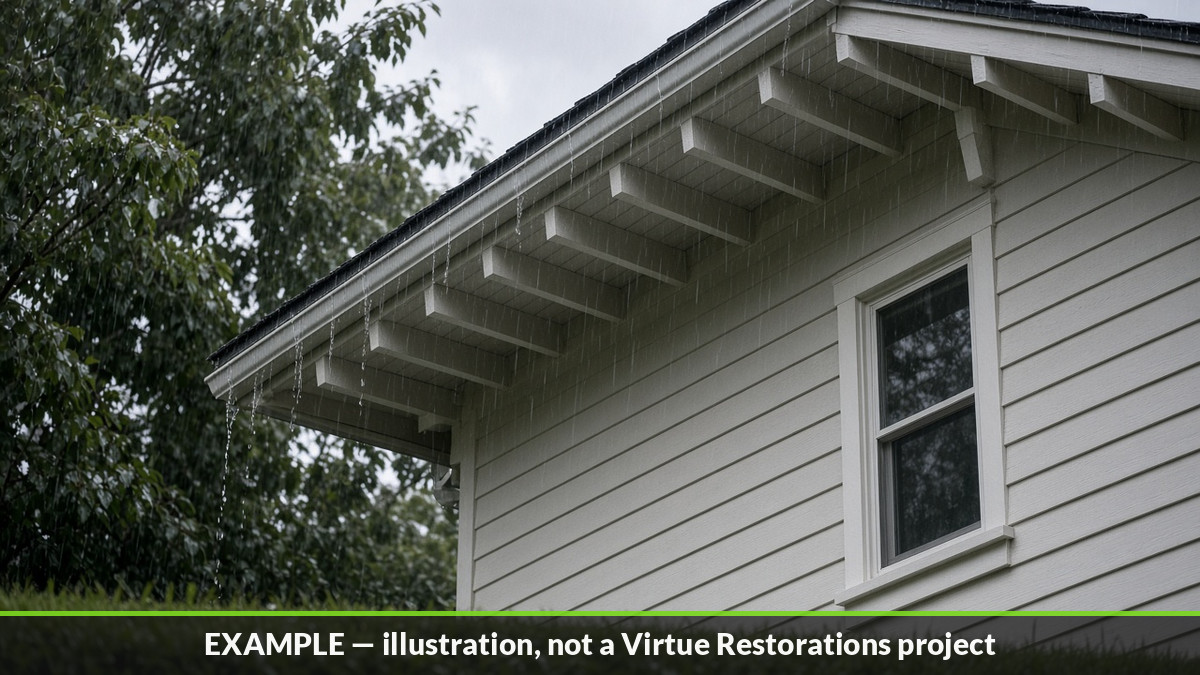
Example illustration, not a Virtue Restorations project