
A Better Way to Build · Day 7 of 30
Gutters, Downspouts, and the Little Flashing That Saves Walls
A kickout flashing costs very little and can prevent hidden rot. Why Build HD calls for kickouts, gutters at every eave, and planned downspouts.
- EXCELLENCE
- BUILD HD™: R903.2 Flashings & Gutters
Some of the most expensive repairs we see start with a part that costs a few dollars.
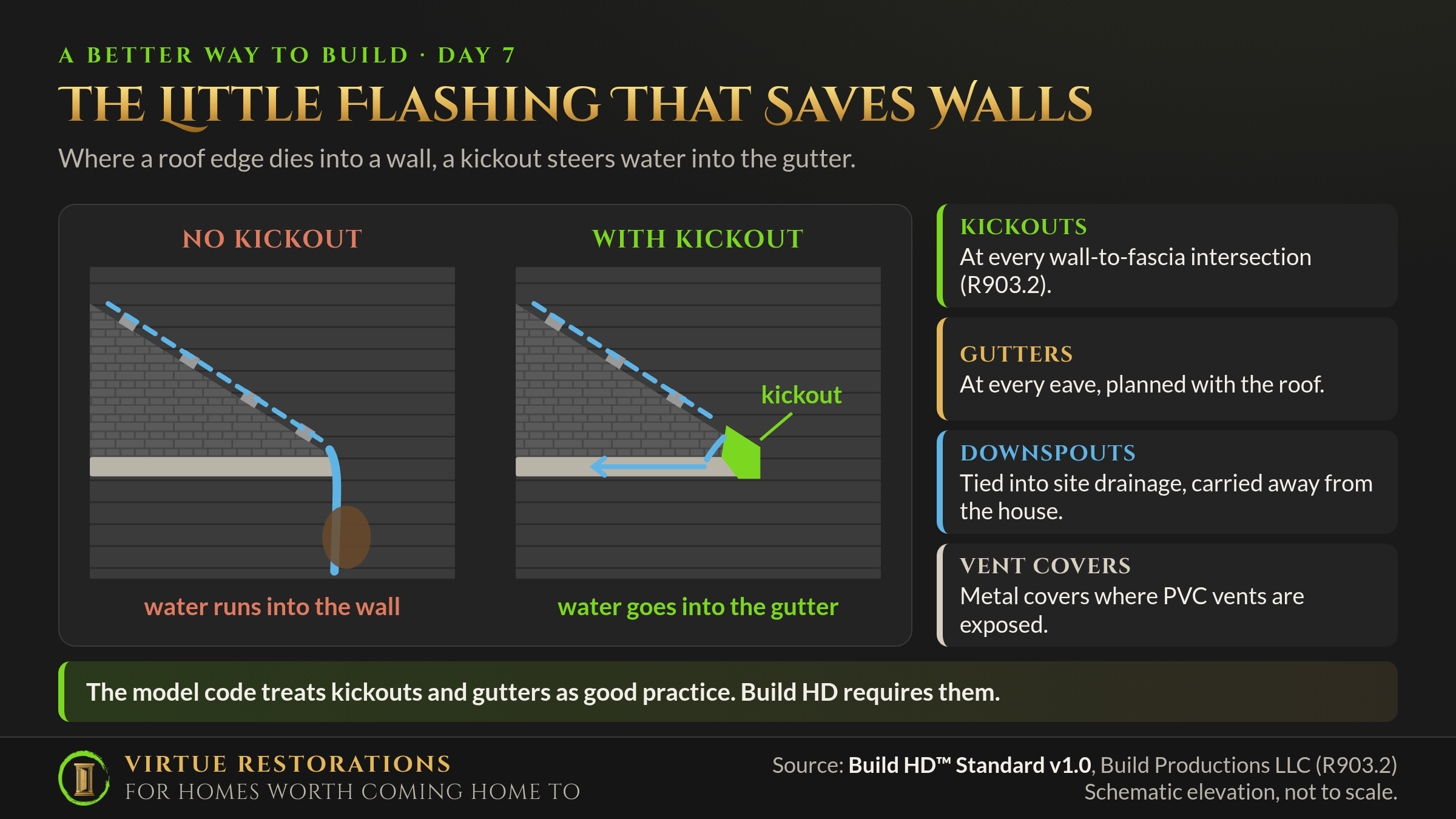
Picture a one-story roof that runs into the side of a two-story wall, like a garage roof against the house or a porch roof against a gable. Where the bottom edge of that roof stops at the wall, there's a spot where all the water running down the roof-to-wall line has to go somewhere. Without the right flashing, it goes into the wall.
The problem
Rain that lands on a roof flows down to the eave and into the gutter. But along a roof-to-wall line, water also runs down the step flashing tucked behind the siding. At the bottom of that line, if nothing turns it outward, the water pours off the end of the flashing and down the face of the wall, often right behind the end of the gutter.
From the outside, everything can look fine for years. Behind the siding, the sheathing and framing below that spot can be soaking up water in every storm. When it finally shows, it's usually as soft siding, stains on an interior wall, or rot found during another project.
Gutters and downspouts have a similar story. A roof with no gutters, or with downspouts that dump next to the house, sends hundreds of gallons of water to the base of the walls and the foundation in a single storm.
What the code requires
The model code requires flashing at roof-to-wall intersections and at valleys. According to the Build HD™ Standard, kickout flashings and gutters are treated as good practice, not universal requirements.
What Build HD calls for
Build HD, published by Build Productions LLC (the team behind Matt Risinger's The Build Show), turns that good practice into a requirement. Its R903.2 entry calls for:
- A kickout flashing at every wall-to-fascia intersection, the spot where a roof edge ends against a wall.
- Wall and head flashings integrated with the roof flashing and the siding, so each layer laps correctly into the next.
- Gutters at all eaves, planned as part of the roof design.
- Downspouts coordinated with site drainage, so the water is carried somewhere useful.
- Metal covers over exposed PVC vents on the roof.
Code minimum
Build HD™ calls for
Why it works
A kickout is a small, angled piece of flashing at the bottom of the roof-to-wall line. Its whole job is to turn the water outward, away from the wall and into the gutter. It's one of the clearest examples of a building-science rule we'll keep coming back to: water follows gravity and surface paths, so give it a path out.
Gutters and downspouts do the same thing on a larger scale. Each inch of rain on a roof adds up to a lot of water. A gutter catches it at the edge, and a downspout moves it to a place where it can soak in or drain away, instead of splashing on the siding and pooling against the foundation.
Metal vent covers are a durability detail. PVC exposed to years of sun can become brittle, and a cracked vent pipe on a roof is another way for water to get in.
What it means when Virtue remodels your existing home
When we work on your roof, siding, or gutters, here's what this looks like:
- Every roof-to-wall intersection we touch gets a kickout. If we're re-roofing or re-siding near that spot, adding one is part of the job, not an upgrade.
- We check the wall below missing kickouts. Where a kickout was never installed, we probe the siding and sheathing below that spot, and we tell you what we find.
- We plan gutters for every eave. When we replace gutters or re-roof, we look at the whole roof, not just the runs that already exist.
- We follow the water to the ground. Downspouts should discharge well away from the foundation, onto splash blocks, extensions, or a drain line that daylights. If a downspout dumps next to the house, we'll show you and recommend a fix.
- We point out exposed PVC vents. When we re-roof, we'll recommend metal covers where vent pipes are exposed to the sun.
The virtue behind it
This post reflects Excellence, our love of good work. A kickout flashing is small and easy to skip, and most homeowners will never know whether it's there. Doing it on every intersection, every time, is the kind of excellence that shows up years later as nothing happening at all.
Water management sits on our integrity floor, so it comes in every project path: Rebuild, Reform, and Reimagine.
Have a roof that runs into a wall and you're not sure what's happening at the bottom? Reach Jacob at Jacob@virtuerestorations.com or (513) 568-5819. We serve Boone, Kenton, Campbell, and Grant counties.
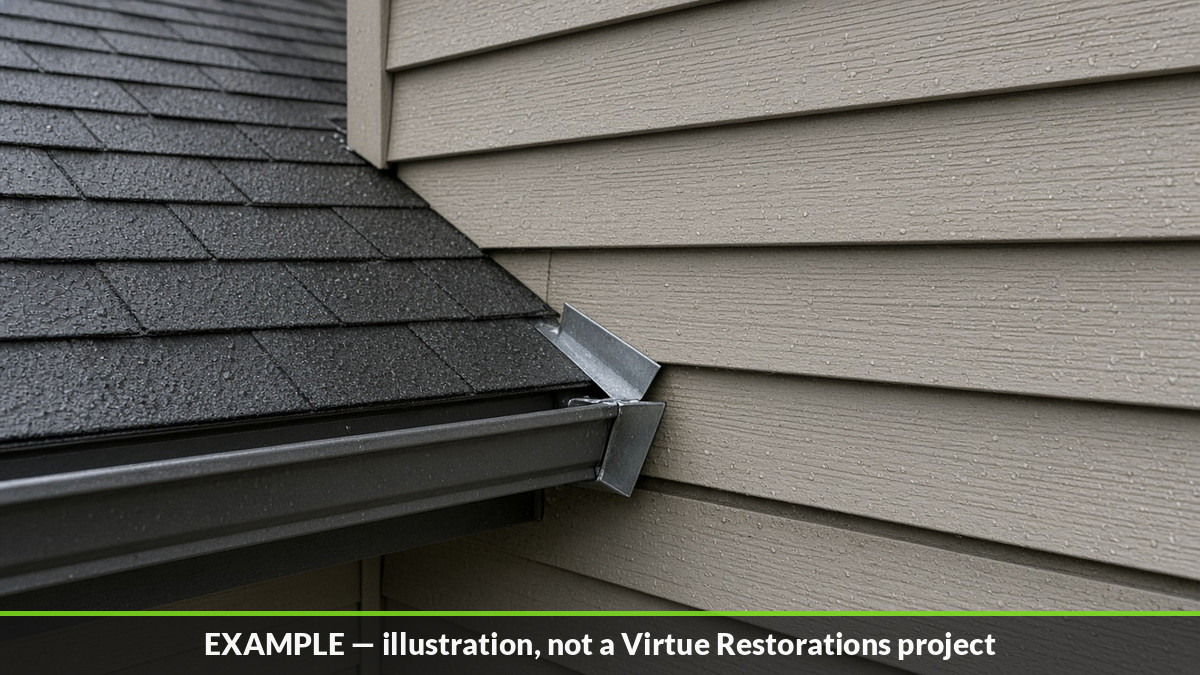
Example illustration, not a Virtue Restorations project