
A Better Way to Build · Day 10 of 30
The Water-Resistive Barrier: Your Home's Real Raincoat
Siding sheds most rain, but the layer behind it does the real work. What Build HD asks of the water-resistive barrier, flashing, and wall penetrations.
- EXCELLENCE
- BUILD HD™: R703.2 Water-Resistant Barrier · R703 Sheet Metal Flashings · R703.1 Exterior Wall Penetrations
Most people think of siding as the thing that keeps rain out of the walls. It does shed most of it. But Build HD's chapter on exterior walls opens with a line worth remembering: cladding is "a rain screen, not a raincoat."
In other words, the siding is the umbrella. The real raincoat is the layer underneath, the water-resistive barrier, or WRB, along with the flashings and seals that tie it together.
The problem
Every type of siding lets some water through. Lap siding has joints and nail holes. Brick and stone absorb water like a sponge. Wind pushes rain up and behind trim. Over time, caulk shrinks and cracks.
The water that gets past the siding lands on whatever is behind it. If that layer is torn, missing, lapped backward, or punched full of unsealed holes, the water reaches the sheathing and framing. Wood that stays wet rots, and wet wall cavities grow mold.
What the code requires
The model code requires at least one layer of water-resistive barrier behind the siding, such as #15 felt or an equivalent housewrap. It requires corrosion-resistant flashing and requires wall penetrations to be flashed and sealed.
What Build HD calls for
The Build HD™ Standard, published by Build Productions LLC (the team behind Matt Risinger's The Build Show), asks for more in three places:
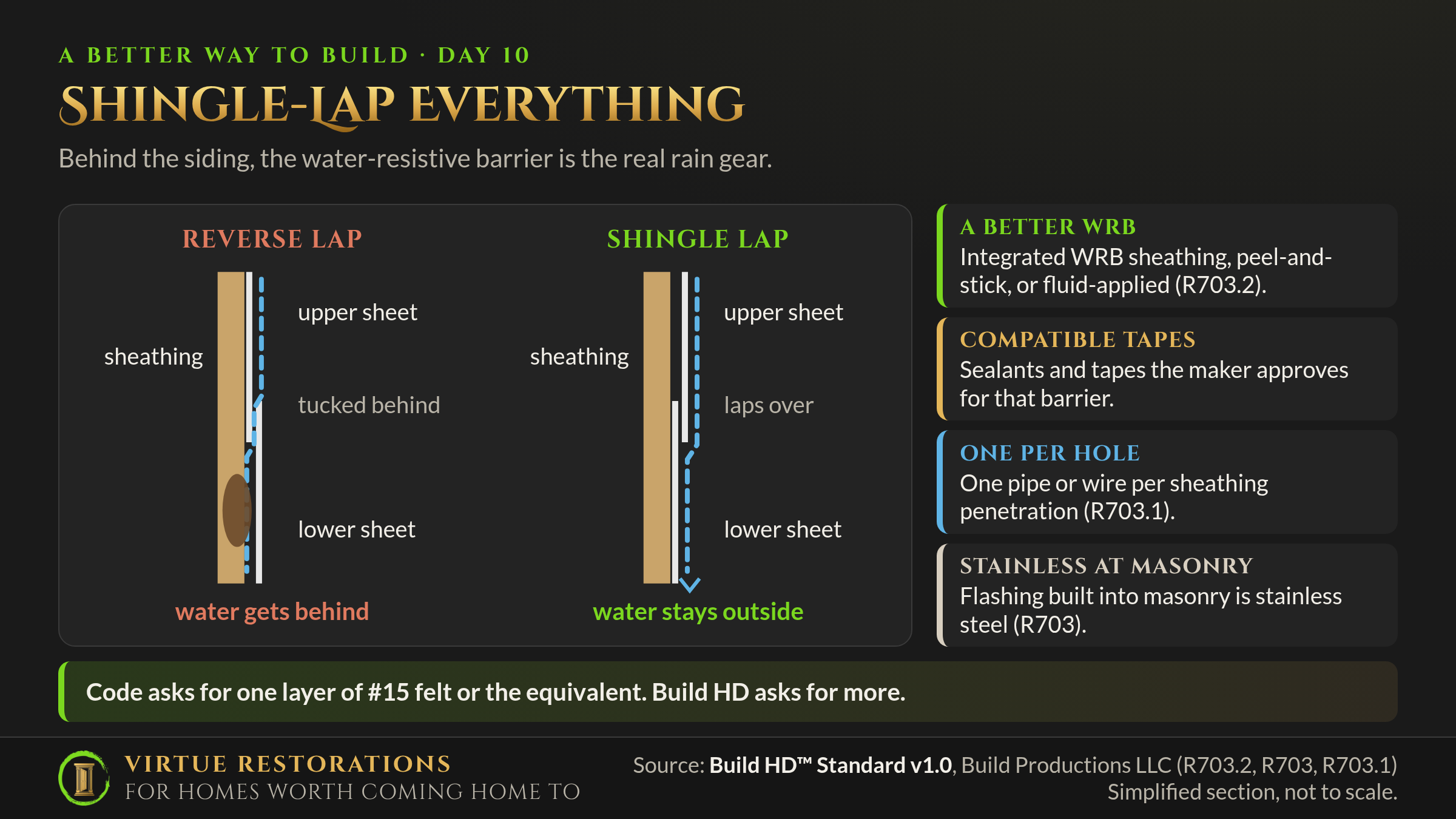
- R703.2, the barrier itself: an integrated WRB sheathing, a peel-and-stick membrane, or a fluid-applied WRB, with sealants and tapes that are compatible and installed per the manufacturer's requirements.
- R703, sheet metal flashing: flashing built into masonry should be stainless steel.
- R703.1, wall penetrations: one wire, pipe, or similar item per hole in the sheathing (refrigerant line sets are the exception), so each one can be sealed properly.
Build HD's broader R703 envelope entry adds that every exterior connection, transition, and penetration should be sealed to keep the air barrier continuous. We'll dig into airtightness in Week 3.
Code minimum
Build HD™ calls for
Why it works
Shingle lapping is the whole game. Water runs downhill, so every upper layer has to overlap the layer below it. The sheet above laps over the sheet below. Flashing over a window head tucks under the barrier above it and laps over the window flange below it. Reverse any one of those laps and you've built a funnel that drains water behind the barrier instead of in front of it.
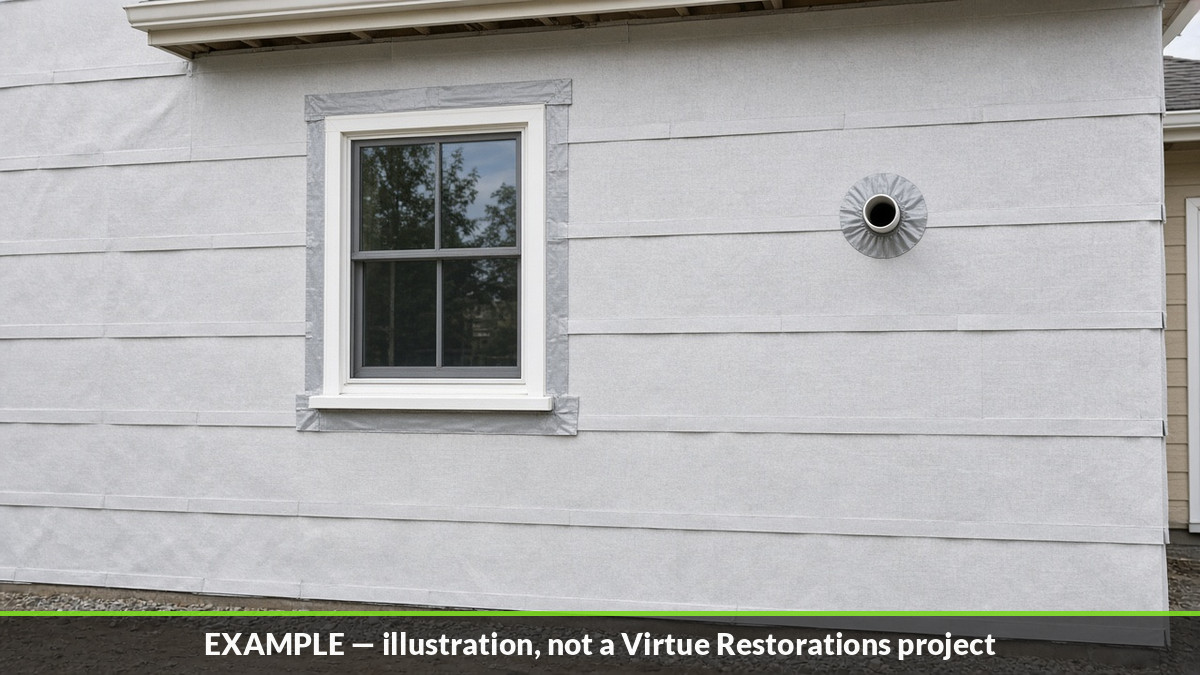
Better materials leave less to chance. Integrated WRB sheathing, peel-and-stick, and fluid-applied barriers bond to the wall or form a continuous skin, with fewer loose laps, staple holes, and torn corners than wrap that's stapled up and later flapped by wind.
Compatible tapes and sealants actually stay stuck. A tape that doesn't bond to a particular barrier can look fine on the day it's installed and peel away a few seasons later. Using what the barrier's maker approves avoids that.
One item per hole sounds fussy, but it's practical. You can seal around one round pipe neatly. A bundle of wires and pipes jammed through one big hole leaves gaps no sealant can fill reliably.
Stainless steel at masonry matters because mortar and wet masonry can corrode ordinary flashing metals over time, and flashing buried in a brick wall is very hard to replace.
What it means when Virtue remodels your existing home
Re-siding is the best chance in decades to fix what's behind your siding. Here's what we do differently:
- We replace the barrier, not just the siding. When we strip siding down to the sheathing, we install a new WRB rather than patching an old, brittle one.
- We lap everything like shingles. Barrier, window and door flashing, and trim flashing all lap in the right order, and we tape with products the barrier's maker approves.
- We repair what we uncover. If the sheathing behind the old siding is soft or stained, we show you, find the source, and repair it before closing back up.
- We clean up penetrations. Where we can, we give each pipe, wire, or vent its own hole with a proper flashing block or seal.
- We photograph the wall before the siding goes on, so you have a record of the layer you'll never see again.
On smaller jobs, like replacing a door or adding an exterior outlet, we tie our new work into your existing barrier the same way: lapped correctly and sealed.
The virtue behind it
This post reflects Excellence, our love of good work. Once the siding goes on, no one will see whether the barrier was lapped right or the tape was the correct kind. Excellence is caring about the layer that nobody sees, because that's the one keeping the house dry.
A properly lapped and sealed barrier sits on our integrity floor whenever we re-side, in every path: Rebuild, Reform, and Reimagine. The specific barrier product may vary by path.
Thinking about new siding? Reach Jacob at Jacob@virtuerestorations.com or (513) 568-5819. We serve Boone, Kenton, Campbell, and Grant counties.
Example illustration, not a Virtue Restorations project