
A Better Way to Build · Day 19 of 30
The Garage Wall: Keeping Fumes and Fire Where They Belong
An attached garage holds cars, fuel, and chemicals beside your living space. Why Build HD treats the garage wall as both an air barrier and a fire barrier.
- COMPASSION
- BUILD HD™: R302.5 Garage Spaces · N1102.4 Air Sealing (garages)
An attached garage is one of the great conveniences of a modern home. It's also a room where we park machines that burn gasoline, store fuel and solvents, and run lawn equipment, all on the other side of a single wall from the kitchen or a bedroom.
That wall has two jobs. It has to keep fire out of the house, and it has to keep air out of the house. Build HD takes both jobs seriously.
The problem
Garages are a common source of indoor air pollution. Car exhaust from a cold start, fumes from gas cans and paint thinners, and pesticides on a shelf can all find their way inside through gaps around the door, through outlets and pipes in the shared wall, and through ducts or attic spaces the garage shares with the house.
Carbon monoxide is the most serious of these. A tighter house (Day 14) actually makes the garage wall more important, because pressure differences can pull garage air through whatever gaps remain.
And garages are where fires often start. The wall and ceiling between garage and house buy time for a family to get out.
What the code requires
The model code requires 1/2-inch gypsum board on the garage side of the shared wall (with 5/8-inch Type X gypsum where there's living space above) and a self-closing door between garage and house. According to the Build HD™ Standard, it does not require a continuous 1-hour lining on every garage surface or a full air-barrier separation.
What Build HD calls for
Build HD, published by Build Productions LLC (the team behind Matt Risinger's The Build Show), calls for this in its R302.5 garage requirement:
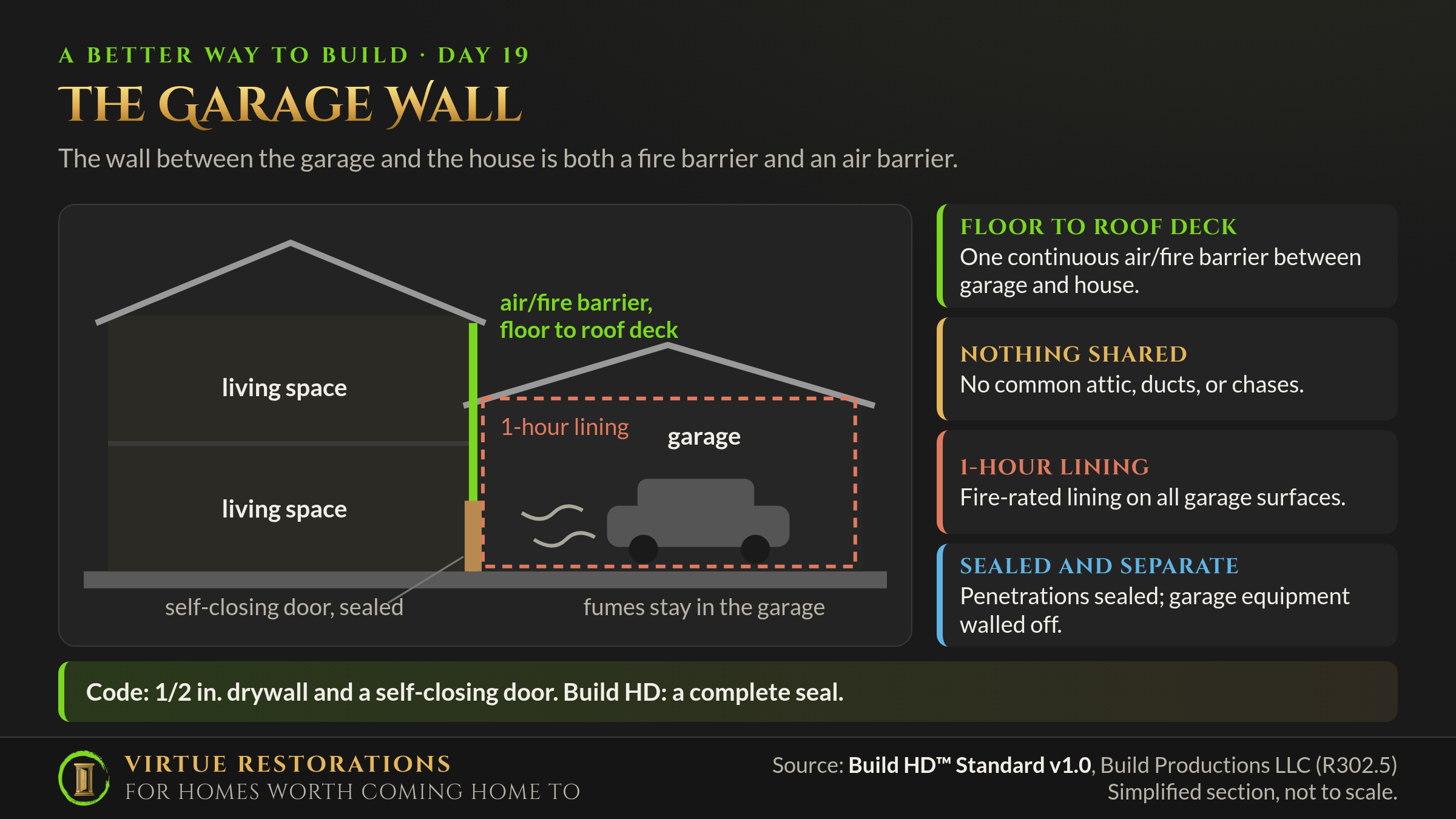
- A continuous air and fire barrier of sheathing or drywall separating the garage from the living space, running from the floor all the way to the roof deck.
- No common attics, ductwork, or chases shared between garage and house.
- Mechanical equipment that serves the house but sits in the garage or garage attic must be partitioned and sealed off from the garage.
- Every penetration through the shared air barrier sealed the same way as an exterior wall.
- A 1-hour fire-rated lining on all garage surfaces, because the garage should be treated as a source of fire.
Its N1102.4 air-sealing entry adds that attached garages should be insulated and isolated from the conditioned envelope.
Code minimum
Build HD™ calls for
Why it works
Continuity is the whole idea. A barrier with gaps isn't a barrier. The most common weak spot is above the ceiling: the shared wall stops at the garage ceiling, and the garage attic and the house attic are one open space. Running the barrier all the way to the roof deck closes that path for both smoke and fumes.
Sharing nothing removes the shortcuts. A duct that runs through the garage, or a return grille in the garage, can draw garage air straight into the house's air system. Keeping ducts, chases, and attics separate removes those shortcuts.
Sealing penetrations like an exterior wall treats the garage as what it is from an air-quality standpoint: outside.
A fire-rated lining buys time. Fire-rated gypsum slows a fire's spread, giving people more time to get out and firefighters more time to respond.
What it means when Virtue remodels your existing home
The garage wall often comes into play when we remodel a kitchen, mudroom, or laundry next to the garage, or a bonus room above it:
- Seal the shared wall and ceiling. When we open the common wall or the ceiling below a room over the garage, we seal every penetration and gap before closing it, using fire-rated materials where required.
- Check the attic line. If the garage attic is open to the house attic, we'll show you and recommend closing it off with a proper barrier.
- Fix the door. We make sure the door between garage and house is self-closing and weatherstripped, as the code requires, and that its frame is sealed.
- No ducts or returns in the garage. If we find a supply or return opening in the garage, or a duct leaking into it, we'll recommend removing or sealing it.
- Keep code separation intact. We never cut into or weaken the required fire separation without restoring it properly.
- Recommend alarms. We'll recommend a carbon monoxide alarm in the living space near the garage door if there isn't one.
The virtue behind it
This post reflects Compassion: love for the neighbor whose home is disrupted. Few things matter more than a family breathing clean air and getting out safely if there's a fire. The garage wall is a quiet line of protection between the people we serve and the hazards parked next door.
Sealing the shared wall and ceiling we touch, and keeping the required separation intact, sit on our integrity floor, in every path. A full 1-hour lining of every garage surface typically comes with a larger garage project. This mapping is provisional while we finalize how Build HD items sit across Rebuild, Reform, and Reimagine.
Remodeling a room next to or above your garage? Reach Jacob at Jacob@virtuerestorations.com or (513) 568-5819. We serve Boone, Kenton, Campbell, and Grant counties.
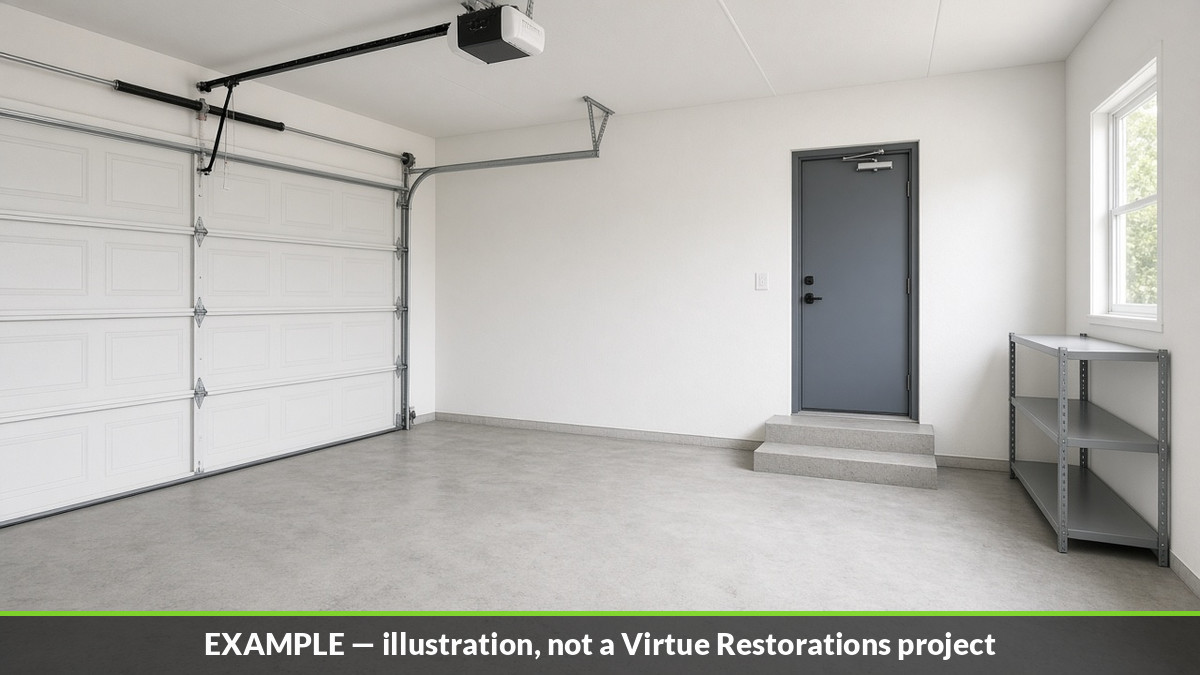
Example illustration, not a Virtue Restorations project