
A Better Way to Build · Day 20 of 30
Leaks Will Happen: Catch Them Early
Every plumbing system eventually leaks. How Build HD plans for it with a main shutoff, leak sensors, and automatic shutoff, and what that means in a remodel.
- HUMILITY
- BUILD HD™: P2904 Water Leak Mitigation · P2903 Water Supply · R307 Wet Areas & Potential Leak Sources · R314 Fire Sensors & Detectors
Weeks 2 and 3 were about keeping rain, air, and vapor out of the house. This week turns to the water we invite in: the supply lines, fixtures, and appliances inside every kitchen and bathroom.
Here's an honest truth from people who build and repair homes for a living: every plumbing system eventually leaks. A supply hose bursts behind a washing machine. A toilet fill valve cracks. A fitting under the kitchen sink weeps for months. The question isn't whether it happens. It's whether you find out in two minutes or two months.
The problem
A burst line can put a lot of water on the floor very fast, and a slow leak inside a wall or cabinet can do just as much damage over time, quietly. By the time a stain shows on a ceiling, the subfloor, drywall, insulation, and framing may all be wet, and mold may already have started.
The insurance numbers show how common and costly this is. According to the Insurance Information Institute (Triple-I), using ISO/Verisk data for 2019–2023, insured homes filed about 1.5 water damage and freezing claims per 100 homes each year, and the average claim paid was about $15,400. That category includes freezing and covered mold, not just plumbing leaks, and it counts only what insurance paid, not the disruption of living through the repair.
What the code requires
According to the Build HD™ Standard, the model code requires a main shutoff valve at the water supply. It does not require floor drains or leak detection at fixtures, or whole-house leak detection.
What Build HD calls for
Build HD, published by Build Productions LLC (the team behind Matt Risinger's The Build Show), treats leaks as something to design for. Across four entries, it calls for:
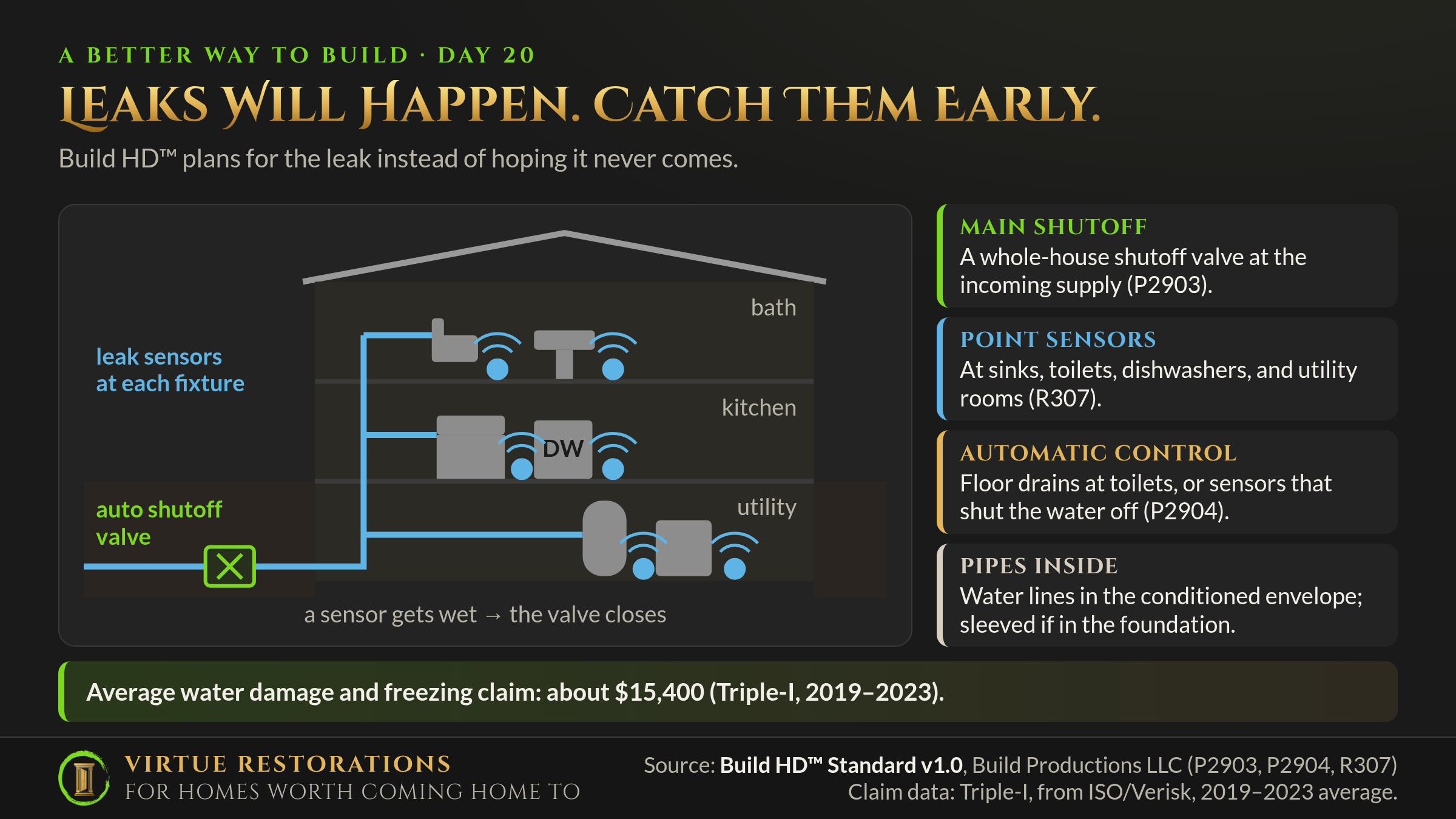
- P2903, water supply: a whole-house shutoff valve at the incoming supply; all water lines inside the conditioned envelope; no plumbing lines in the foundation unless sleeved for future repair; and monitored point-source leak detectors or whole-house leak detection.
- P2904, leak mitigation: a floor drain at each toilet, or leak detectors with an automated control system.
- R307, wet areas: floor drains or monitored leak detectors at all sinks, toilets, dishwashers, and utility rooms.
- R314, detectors: sensors designed into garage, attic, and storage spaces, and a whole-house leak detector at the incoming water source.
Code minimum
Build HD™ calls for
Why it works
Sensors turn a disaster into a nuisance. A small leak sensor sits on the floor under a sink, behind a toilet, or beside a washer or water heater. When it gets wet, it sends an alert. Paired with a motorized valve on the main line, it can shut the water off automatically, even when nobody's home.
A whole-house shutoff is the last line of defense. Even without automation, a main valve that's easy to find and easy to turn means anyone in the family can stop a leak in seconds. Too many homes have a main valve that's buried behind boxes, seized from age, or that nobody knows how to find.
Pipes inside the envelope don't freeze. Keeping water lines out of exterior walls, attics, and crawlspaces (Days 17 and 18) removes the most common cause of winter pipe bursts.
Sleeves make repairs possible. A pipe run through a sleeve under a slab can be pulled and replaced, instead of jackhammering the floor.
What it means when Virtue remodels your kitchen or bathroom
Kitchens and baths are the heart of our work, and they're where most supply water lives. On those projects:
- We find and tag the main shutoff. On every project, we locate the main water shutoff, make sure it works, label it, and show you where it is. If it's seized or missing, we'll recommend replacing it.
- New supply lines and stops on everything we touch. When we set or reconnect a sink, toilet, dishwasher, or ice maker, we replace the old supply lines and shutoff valves (stops) instead of reusing them.
- Leak sensors as standard practice. On kitchen and bath remodels, we'll recommend point leak sensors at the sink base, toilet, dishwasher, and any nearby laundry or water heater.
- Automatic shutoff as an upgrade. On larger projects, we'll offer a motorized whole-house shutoff valve that closes when a sensor gets wet.
- Keep pipes warm. We avoid running new supply lines in exterior walls or unconditioned spaces, and when we can't avoid it, we'll explain how they're protected.
- Test before we close. New supply piping is pressure-tested before walls and floors close.
The virtue behind it
This post reflects Humility: be willing to learn, and claim only what we can deliver. No builder can promise a house will never leak. Humility means admitting that things fail and planning for it, so that when a fitting gives out years from now, the damage is a towel's worth, not a remodel's worth.
Finding and tagging the main shutoff, and replacing the supply lines and stops we touch, sit on our integrity floor, in every path. Leak sensors fit every path from Rebuild up, and an automatic shutoff valve typically fits Reform or Reimagine. This mapping is provisional while we finalize it.
Planning a kitchen or bath? Reach Jacob at Jacob@virtuerestorations.com or (513) 568-5819. We serve Boone, Kenton, Campbell, and Grant counties.
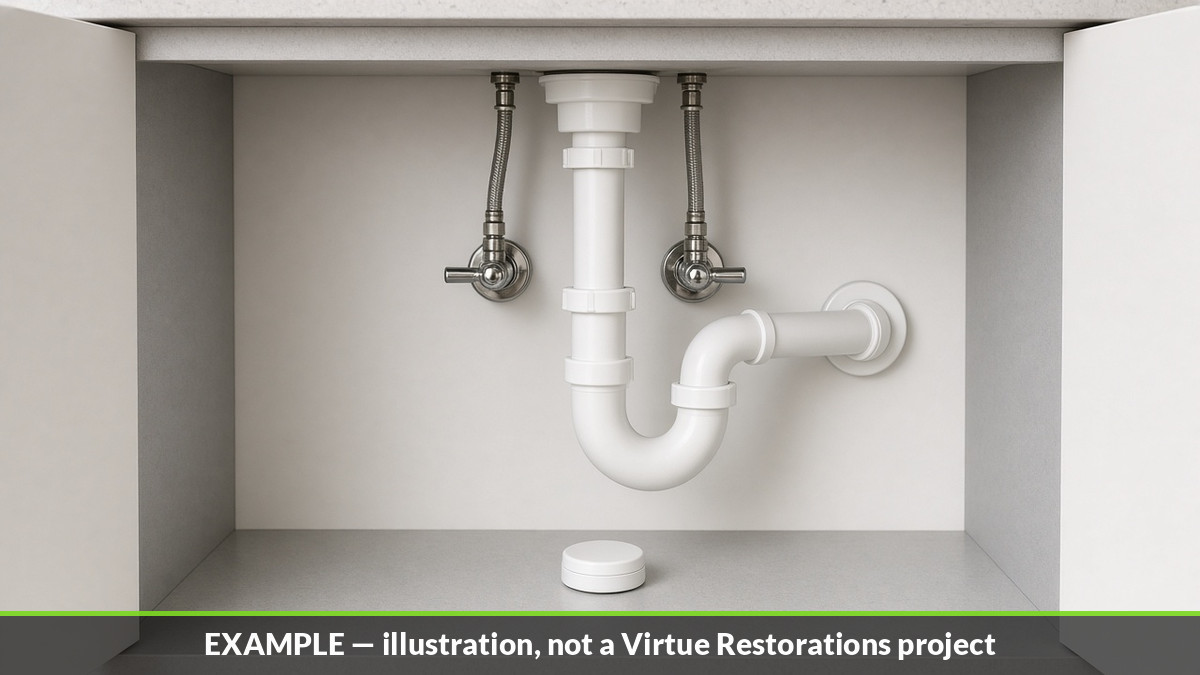
Example illustration, not a Virtue Restorations project