
A Better Way to Build · Day 12 of 30
Roofing That Lasts: Shingles, Metal, and the Details Between
Most roof leaks start at valleys, edges, and openings. What Build HD asks of shingles, metal roofs, underlayment, flashing, and skylights.
- VALOR
- BUILD HD™: R905.2 Asphalt Roofing · R905.10 Metal Roofing · R903.2 Flashings & Gutters · R308.6 Skylights
A roof is the hardest-working part of a house. It takes direct sun, hail, wind, snow, ice, and every drop of rain, and it does it year after year with almost no attention.
It's also the most disruptive part to redo. That's why Build HD's roofing chapter says the standard "raises the baseline well above three-tab shingles on felt."
The problem
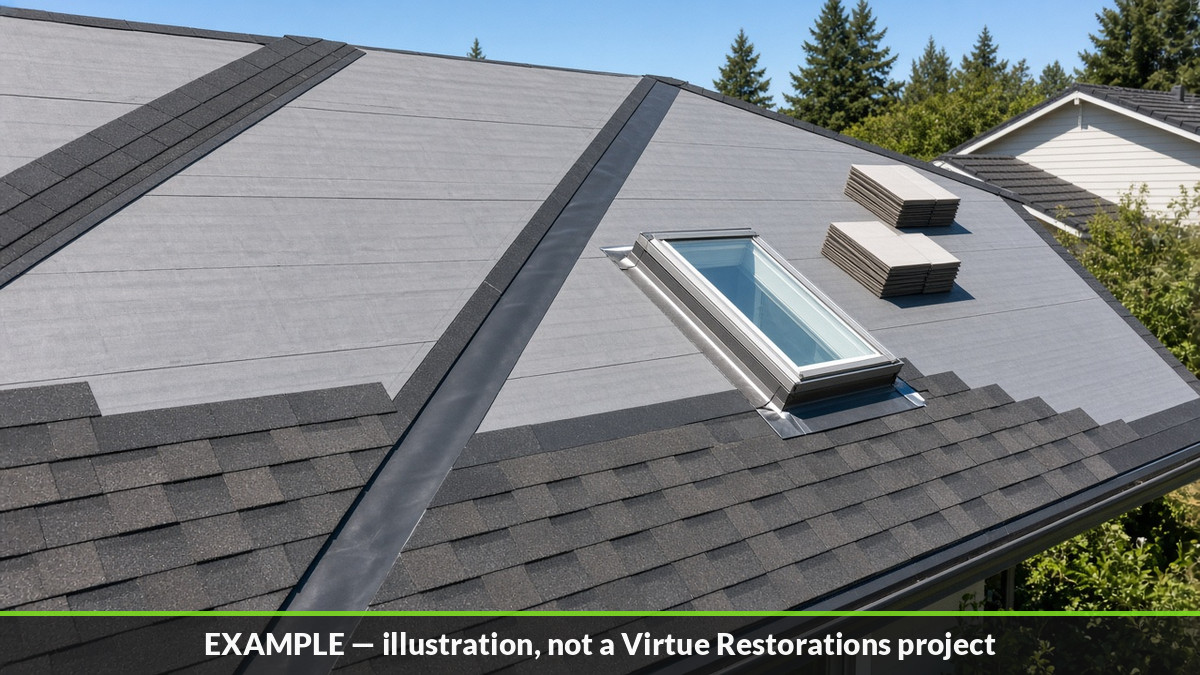
When a roof leaks, it rarely leaks in the middle of a big, open slope. It leaks where something interrupts the roof: valleys where two slopes join, low-slope sections where water moves slowly, walls and chimneys that rise through the roof, vents and other penetrations, and skylights.
Those are the places where the roofing material alone can't do the job, and where the layers underneath and the flashing around them decide whether water stays out.
What the code requires
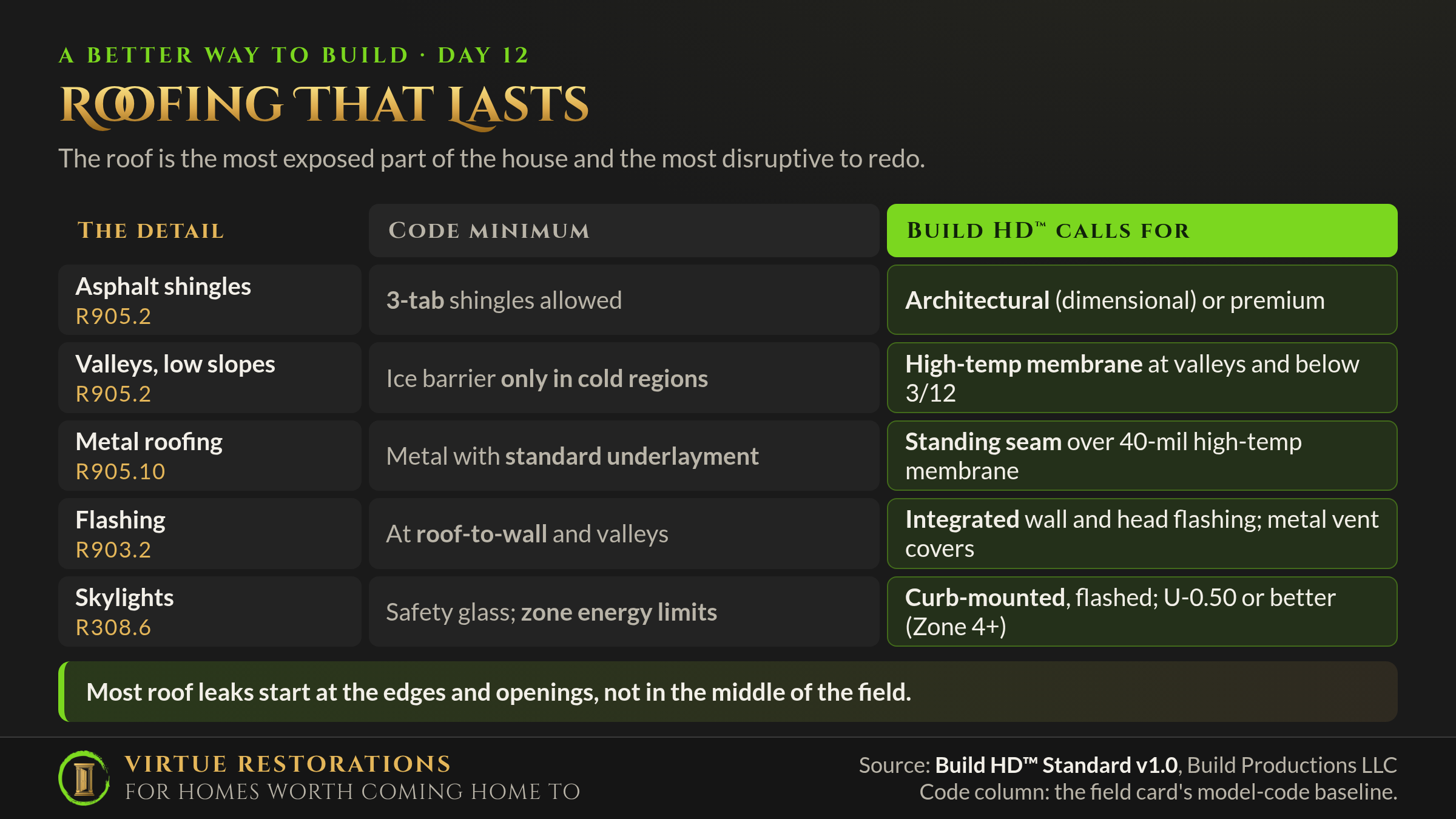
According to the Build HD™ Standard and its inspector field card, the model code:
- Allows standard three-tab asphalt shingles over underlayment, with an ice barrier required only in cold regions.
- Allows prescriptive metal roofing with standard underlayment.
- Requires flashing at roof-to-wall intersections and valleys.
- Requires safety glazing in skylights and sets energy limits by climate zone, though not Build HD's specific values.
What Build HD calls for
Build HD, published by Build Productions LLC (the team behind Matt Risinger's The Build Show), calls for:
- R905.2, asphalt roofs: at minimum, architectural (dimensional) or premium shingles, with a high-temperature waterproof underlayment membrane in valleys and on any slope below 3/12.
- R905.10, metal roofs: at minimum, standing seam over a 40-mil high-temperature waterproof underlayment or equivalent (the high-temperature rating isn't required in colder climate zones).
- R903.2, flashing: wall and head flashings integrated with the roof and siding, kickouts at every wall-to-fascia intersection (Day 7), gutters at every eave, and metal covers on exposed PVC vents.
- R308.6, skylights: curb-mounted with appropriate flashing and waterproofing, and, in climate zones 4 and above (Northern Kentucky is zone 4A), a U-factor of 0.50 or better.
Why it works
Underlayment is the second line of defense. Shingles shed water, but wind-driven rain and ice dams can push water under them. A self-adhering waterproof membrane seals around the nails that pass through it, which is why it belongs in valleys and on low slopes, where water moves slowly and concentrates. The high-temperature rating matters because roof decks get very hot in summer, and some membranes soften or break down under that heat.
Better shingles hold up better. Architectural shingles are thicker and heavier than three-tab shingles, with layered tabs. Manufacturers generally rate them for higher winds and longer service than basic three-tab products.
Standing seam hides its fasteners. On a standing-seam metal roof, the panels are joined at raised seams and held down with concealed clips. There are no exposed screws with rubber washers to dry out and leak over time.
Curb-mounted skylights lift the joint out of the water. A curb raises the skylight above the roof surface, so the flashing can lap up and around it the same way it does at a chimney. That gives water a clean path around the opening instead of right at the glass edge.
What it means when Virtue remodels your existing home
A re-roof is the moment to get these details right, because you won't see them again for decades.
- We tear off; we don't layer over. Stripping to the deck lets us inspect and repair the sheathing and see how water has been behaving.
- Our shingle baseline is architectural. We install architectural shingles or better, guided by Build HD's R905.2.
- Valleys and low slopes get high-temperature membrane. That's standard on our re-roofs, not an add-on.
- We replace flashing rather than reuse tired metal. That includes step flashing at walls, a kickout at every roof-to-wall intersection we touch, and metal covers on exposed PVC vents.
- Skylights get a curb. When we replace or add a skylight, it's curb-mounted and flashed.
- We'll tell you the truth about bids. Our roof price may be higher than a bid that reuses flashing and skips the membrane. We'll show you, line by line, what's included and why, so you can compare honestly.
The virtue behind it
This post reflects Valor, the courage to tell the truth and do the hard right work. The easiest way to win a roofing job is to be the lowest number. It takes courage to walk a homeowner through what the cheaper bid leaves out, and to stand behind a price that includes the parts nobody will ever see.
Underlayment, membrane, and new flashing sit on our integrity floor, in every path. The roofing material itself is where the paths differ: architectural shingles are our floor in Rebuild, Reform, and Reimagine, and standing-seam metal fits Reimagine. (This mapping is provisional while we finalize how Build HD items sit across the paths.)
Is your roof nearing the end of its life? Reach Jacob at Jacob@virtuerestorations.com or (513) 568-5819. We serve Boone, Kenton, Campbell, and Grant counties.
Example illustration, not a Virtue Restorations project