
A Better Way to Build · Day 25 of 30
Fresh Air on Purpose: ERVs and Bath Fans
A tighter house needs planned fresh air. How an ERV brings in fresh air while saving energy, why Build HD asks for one, and what we do with bath fans in every bathroom remodel.
- COMPASSION
- BUILD HD™: M1507 Ventilation
"Houses need to breathe." It's one of the most common things people say about homes, and it's half right. People need fresh air. Houses need to stay dry. In the past, leaky walls supplied fresh air by accident, along with drafts, dust, humidity, and high energy bills.
When we tighten a house (Day 14), we take away that accidental air. That's a good thing, as long as we replace it with fresh air on purpose.
The problem
According to the U.S. Environmental Protection Agency's Report on the Environment, Americans spend about 90 percent of their time indoors, where concentrations of some pollutants are often 2 to 5 times higher than typical outdoor concentrations. The EPA also notes that indoor levels of some pollutants have risen partly because of energy-efficient construction when it lacks sufficient mechanical ventilation.
Indoor air picks up moisture from showers and cooking, odors, carbon dioxide from breathing, and chemicals from cleaning products, furnishings, and building materials. Without a steady supply of fresh air, they build up.
Humidity matters too. The EPA's guide to mold and moisture recommends keeping indoor relative humidity below 60 percent, ideally between 30 and 50 percent, and running the bathroom fan when you shower.
What the code requires
According to the Build HD™ Standard, the model code requires whole-house mechanical ventilation at a rate based on floor area and bedrooms, plus local exhaust at bathrooms and kitchens. A balanced ERV or HRV is not required.
What Build HD calls for
Build HD, published by Build Productions LLC (the team behind Matt Risinger's The Build Show), calls for this in its M1507 ventilation requirement:
- At least one whole-house ERV (energy recovery ventilator).
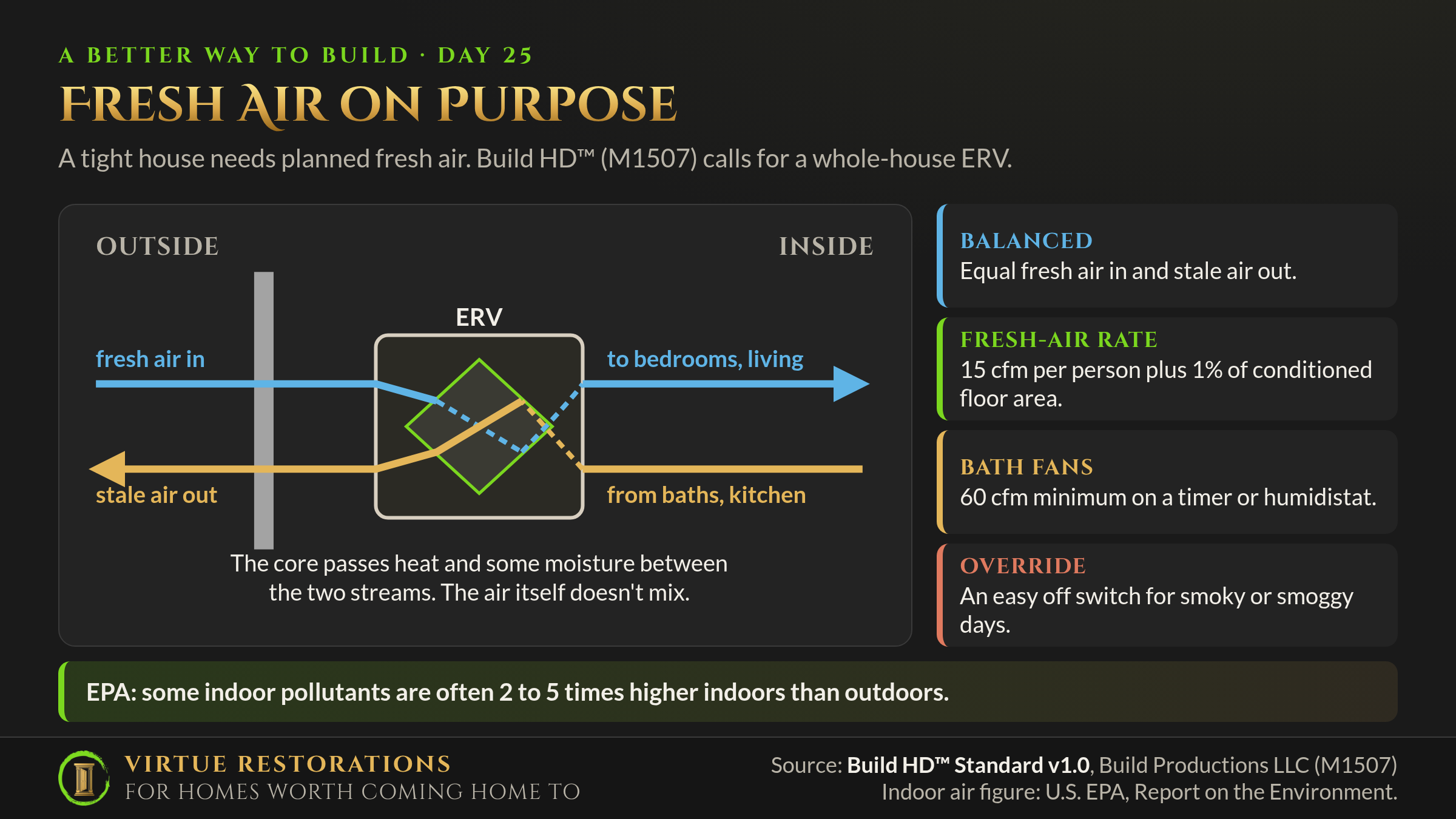
- A fresh-air rate of 15 cfm per person-equivalent plus 1% of the conditioned floor area. For example, for four people in a 2,000 sq ft home: 60 + 20 = 80 cfm.
- Bathroom spot ventilation of at least 60 cfm wherever a bath isn't served by the whole-house system, controlled by a timer or humidistat.
- Continuous bath ventilation of at least 20 cfm allowed when it's connected to a balanced ERV or HRV.
- An accessible override to shut the system off when outdoor air is worse than indoor air: wildfire smoke, ozone, smog, or fumes.
Code minimum
Build HD™ calls for
Why it works
Balanced means predictable. An ERV moves the same amount of air out as it brings in. Fresh air goes where people spend time, like bedrooms and living areas. Stale air comes out of the rooms that make it, like bathrooms and kitchens.
Energy recovery cuts the cost of fresh air. Inside the ERV, the outgoing and incoming air streams pass on opposite sides of a core. Heat moves across, and in an ERV, some moisture does too, but the air itself doesn't mix. In winter, outgoing warm air preheats incoming cold air. In summer, the core helps keep some of the outdoor heat and humidity out. (An HRV recovers heat but not moisture.)
Planned air is filtered air. Air that leaks in through walls and crawlspaces comes through insulation, dust, and dirt. Air that comes in through an ERV comes through a filter.
Bath fans control the biggest moisture source. A properly sized fan, ducted outdoors and run on a timer or humidistat so it keeps running after the shower, removes moisture before it soaks into drywall and paint.
What it means when Virtue remodels your existing home
Bathrooms are one of our most common projects, so this part is very practical:
- Every bathroom we remodel gets a real fan. At least 60 cfm, ducted to the outdoors (never into the attic), on a timer or humidistat so it runs long enough after a shower.
- Kitchen hoods vent outside. When we install a range hood, we duct it outdoors rather than recirculating, whenever the house allows. (More on big hoods tomorrow.)
- Tighter house, planned ventilation. When a project includes significant air sealing, we'll review the home's ventilation and recommend a plan, which may be an ERV.
- ERVs on whole-house projects. On major remodels and additions, we'll include a whole-house ERV as our recommended option, with an easy override for smoky days.
- Basements need fresh air too. When we finish a basement, we plan its ventilation and humidity control along with the HVAC.
We can't promise how any family will feel in their home. What we can do is follow the EPA's guidance on ventilation and humidity, and build systems that make good air the default.
The virtue behind it
This post reflects Compassion: love for the neighbor whose home is disrupted. The air inside a house is something a family lives in every hour of every day. Making it a little fresher and drier, quietly and automatically, is one of the kindest things a remodel can do.
A properly sized, ducted bath fan on a timer or humidistat, and a ventilation review after major air sealing, sit on our integrity floor, in every path. A whole-house ERV typically fits Reform or Reimagine. This mapping is provisional while we finalize it across Rebuild, Reform, and Reimagine.
Planning a bathroom or whole-house project? Reach Jacob at Jacob@virtuerestorations.com or (513) 568-5819. We serve Boone, Kenton, Campbell, and Grant counties.
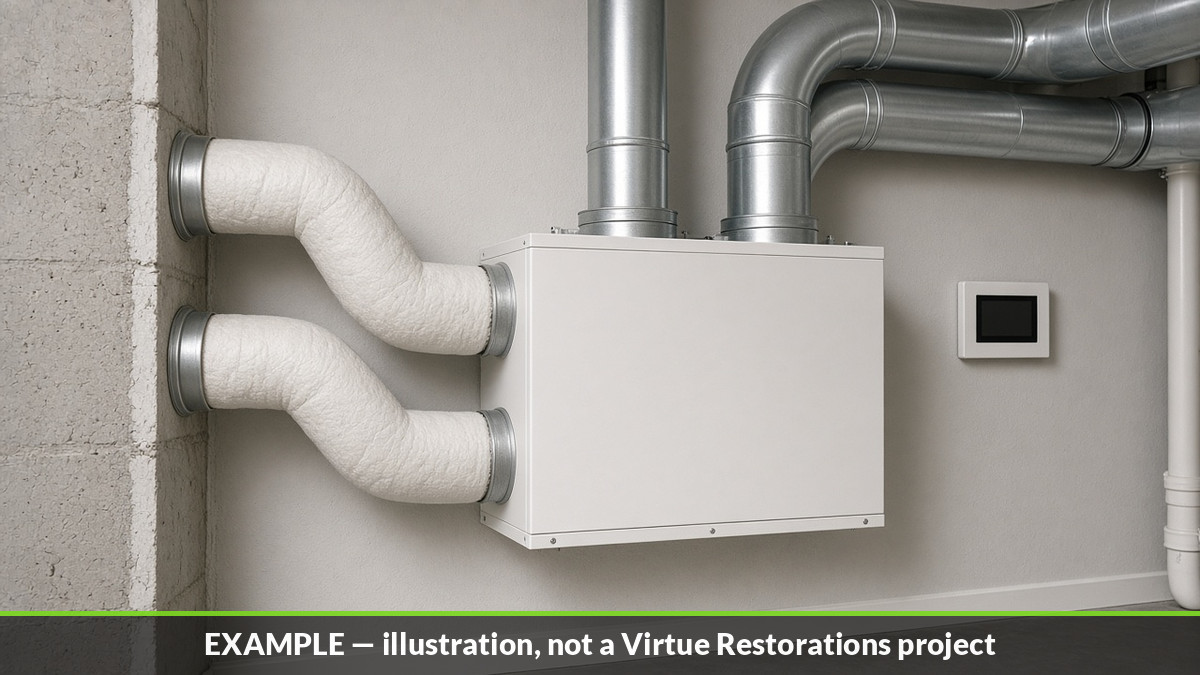
Example illustration, not a Virtue Restorations project