
A Better Way to Build · Day 27 of 30
Ducts and Filtration
Leaky ducts and thin filters undercut a good HVAC system. Why Build HD calls for sealed, rigid, tested ducts and 4-inch MERV 13 filters, and how we treat ducts in a remodel.
- HUMILITY
- BUILD HD™: M1601 Ductwork · M1601 Air Filtration
Ducts are the lungs of a forced-air system, and filters are its nose. Both are easy to ignore because they're hidden in walls, ceilings, and basements. But a well-sized furnace or air conditioner (Day 24) can only perform as well as the ducts that carry its air and the filter that cleans it.
The problem
Leaky ducts waste air and pull in dirty air. Joints that were never sealed, crushed flex duct, and disconnected runs are common. Supply leaks push conditioned air into walls, attics, and crawlspaces. Return leaks pull air in from those same places, with dust, insulation fibers, and humidity, and send it through the house.
Thin filters do little, or too much. Many systems use a 1-inch filter. A basic one catches mostly larger dust. A high-efficiency 1-inch filter catches more but has little surface area, so it can restrict airflow, especially as it loads up.
What the code requires
According to the Build HD™ Standard, the model code requires duct sealing and limits total duct leakage to about 4 cfm per 100 sq ft of floor area, with duct insulation by zone. It requires a filter in the return air path, but no specific MERV rating or filter depth.
What Build HD calls for
Build HD, published by Build Productions LLC (the team behind Matt Risinger's The Build Show), sets two M1601 requirements:
- Ductwork: all ducts sealed and rigid, with external insulation and a vapor barrier (except the last 10 feet of each register drop). A duct leakage test is required, with a maximum of 3 cfm per 100 sq ft of conditioned floor area after construction or at rough-in with the air handler installed, or 2 cfm per 100 sq ft at rough-in without it.
- Filtration: 4-inch pleated filters at least MERV 13 at all returns, with enough area to minimize airflow restriction, in easy-to-reach locations for replacement.
Code minimum
Build HD™ calls for
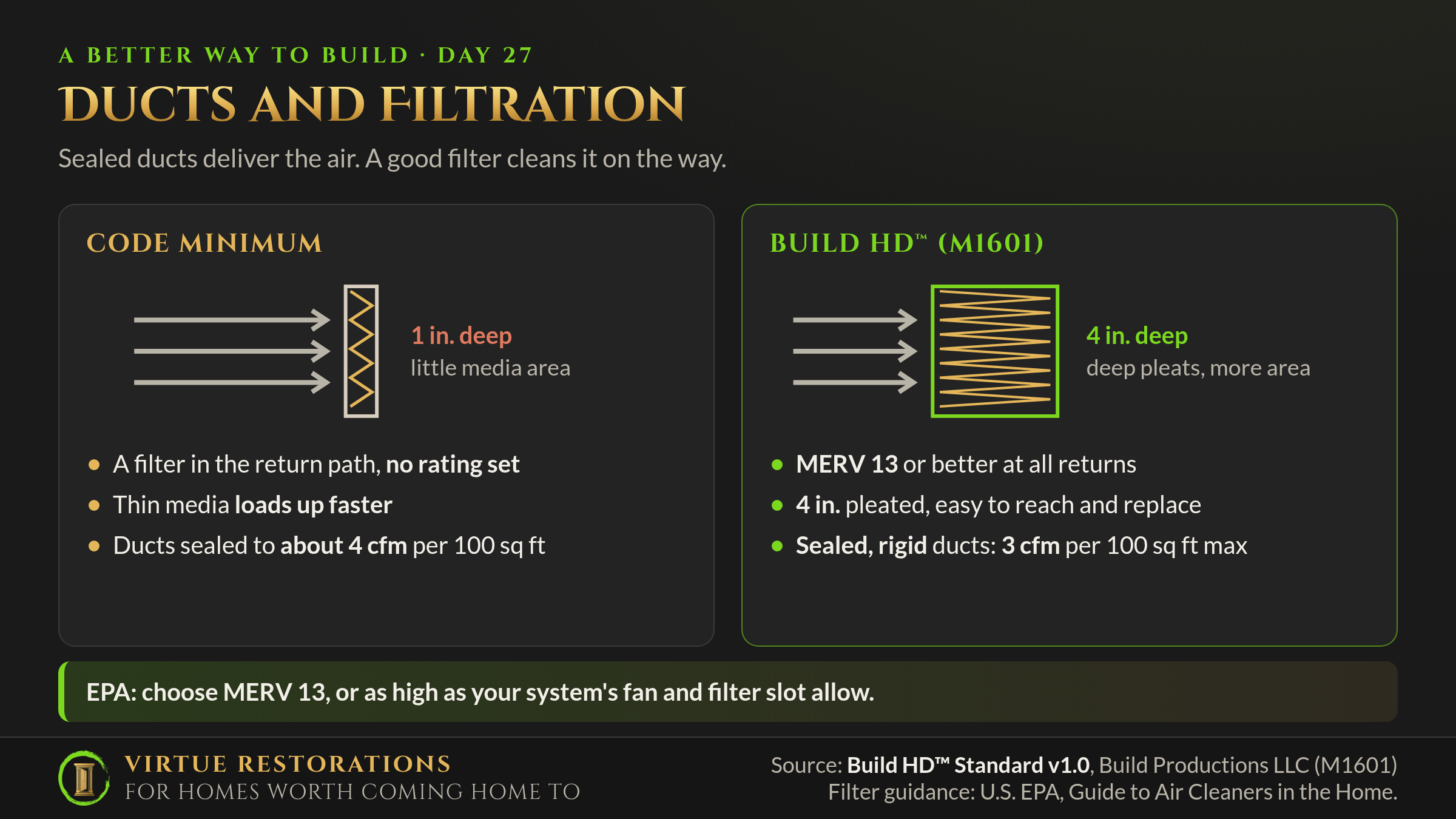
Why it works
Sealed, rigid ducts deliver what was designed. Rigid metal ducts with sealed joints hold their shape, keep their size, and don't sag or kink. A leakage test proves they're tight.
MERV 13 captures fine particles. The EPA's Guide to Air Cleaners in the Home recommends a furnace or HVAC filter rated at least MERV 13, or as high as your system's fan and filter slot can accommodate. The EPA notes that filters rated MERV 13 and above must show at least 50% removal of the smallest particles tested.
Depth adds area. A 4-inch pleated filter packs far more filter media into the same opening than a 1-inch filter does. More media generally means less restriction to airflow at the same rating, and a longer time between changes.
Access means it actually gets changed. A filter behind a hard-to-reach panel tends to get forgotten. The EPA also advises asking an HVAC professional before upgrading filters, because each system can handle a different level of filtration.
A good filter is one part of indoor air quality, not a cure-all. It works with source control, ventilation (Day 25), and humidity control.
What it means when Virtue remodels your existing home
Most homes we work in have ducts we didn't install. Here's how we treat them:
- Seal what we touch. When we open walls, ceilings, or floors, we seal the duct joints and boots we can reach with mastic or approved tape, and we seal the gap between each register boot and the drywall or floor.
- Protect ducts from construction dust. During demolition, drywall sanding, and floor refinishing, we cover registers and returns and don't let the system pull in construction dust. When the dust settles, we'll recommend a fresh filter.
- Test when replacing equipment. When a project includes new HVAC equipment, we'll recommend a duct leakage test and sealing as part of the job, aiming for Build HD's targets.
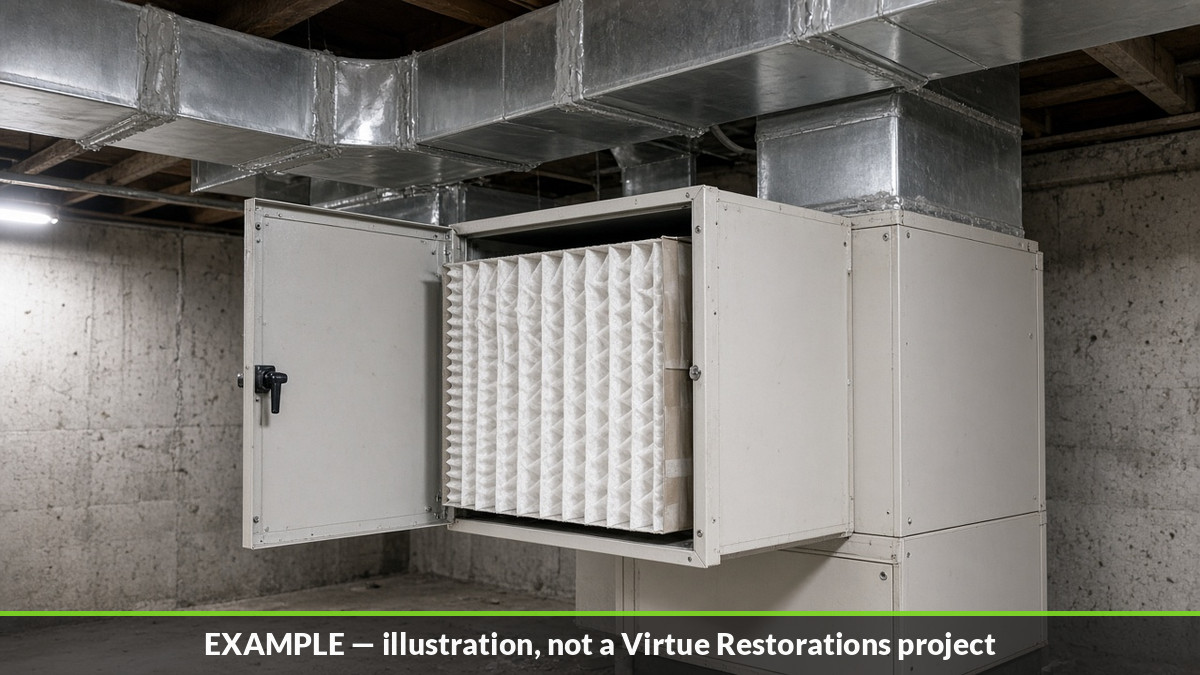
- A 4-inch filter cabinet. With new equipment, we'll recommend a 4-inch filter cabinet sized for a MERV 13 filter, in an easy-to-reach spot, and have our HVAC partner confirm the system's airflow can handle it.
- No new flex runs in place of trunks. In finished basements and additions, we use rigid, sealed ductwork for main runs, keeping any flexible duct to short final connections.
The virtue behind it
This post reflects Humility: be willing to learn, and claim only what we can deliver. It's tempting to promise "cleaner, healthier air" with a filter upgrade. The honest version is more modest: following the EPA's guidance, a sealed duct system and a good filter remove more particles from the air your system moves. We'll tell you what we did, show you the test results, and leave the claims to the experts.
Sealing the ducts we touch, protecting them from construction dust, and keeping filters easy to reach sit on our integrity floor, in every path. A duct leakage test and a 4-inch MERV 13 filter cabinet fit from Rebuild up, usually alongside equipment replacement. This mapping is provisional while we finalize it across Rebuild, Reform, and Reimagine.
Wondering what's going on inside your ducts? Reach Jacob at Jacob@virtuerestorations.com or (513) 568-5819. We serve Boone, Kenton, Campbell, and Grant counties.
Example illustration, not a Virtue Restorations project